
Google can now answer a buyer’s question before they ever reach a traditional results page. If your brand is absent from that answer, a first-page ranking may no longer deliver the visibility it once did. This AI overview optimisation guide is for teams that need to earn a place in AI-generated answers, measure whether they are succeeding, and act before competitors turn answer visibility into market share.
AI Overviews are not simply another rich result to tick off in an SEO report. They pull together information from multiple sources, interpret intent, and present a direct response that may include linked citations, recommendations, comparisons and caveats. The commercial contest has shifted: brands are competing to be selected as evidence, not merely clicked as a result.
What AI Overview optimisation actually means
AI Overview optimisation is the work of making your brand and content easier for generative search systems to understand, trust and cite when answering relevant questions. It sits within the broader discipline of Generative Engine Optimisation, or GEO.
That means more than publishing pages with target keywords. A generative system needs to identify what you offer, who it suits, why it is credible, and how it compares with alternatives. It must also find information that directly resolves the question being asked. A polished brand site that says plenty but answers little can be invisible in this environment.
There is no switch that guarantees inclusion in Google AI Overviews. Results vary by query, industry, location, freshness and the sources available to the system. But brands can materially improve their odds by building clear, evidence-led assets and monitoring how they perform across the prompt set that matters commercially.
Start with the questions that create revenue
The wrong starting point is a generic list of high-volume keywords. AI search often appears around longer, decision-stage queries: “best payroll software for a 50-person business”, “how to choose a solar installer”, or “is [product category] worth it for agencies”. These are the moments when a buyer wants synthesis, not ten blue links.
Map questions across the buyer journey. Early-stage prompts reveal the language, problems and criteria that shape demand. Mid-stage prompts surface comparisons, use cases and implementation concerns. Bottom-of-funnel prompts expose the brands being recommended, the proof being cited and the objections still blocking action.
For each priority topic, record the exact prompt, the overview’s response, cited domains, mentioned brands and sentiment. Include variations that reflect how Australians actually search, such as local service areas, pricing in AUD, compliance requirements or industry terminology. AI answers are not static, so run this on a schedule rather than treating a single manual check as a benchmark.
Build pages that answer, prove and clarify
Generative search rewards useful source material, not vague positioning. Your content should give an AI system concise claims it can safely use, backed by the detail a buyer needs to trust them.
Start by tightening the fundamental facts across your site: what the product or service does, its ideal customer, operating regions, pricing model where appropriate, support options, technical requirements and differentiators. Contradictory descriptions across product pages, FAQs, media coverage and third-party profiles create ambiguity. Ambiguity is expensive when a model has several competitors it could name instead.
Then create content around decision-making questions. A strong comparison page explains where your offer fits and where it may not. A practical guide shows the process, inputs, expected outcomes and common mistakes. A category page defines the problem and selection criteria before introducing your solution. These formats give AI systems useful language for recommendations without forcing every page into a sales pitch.
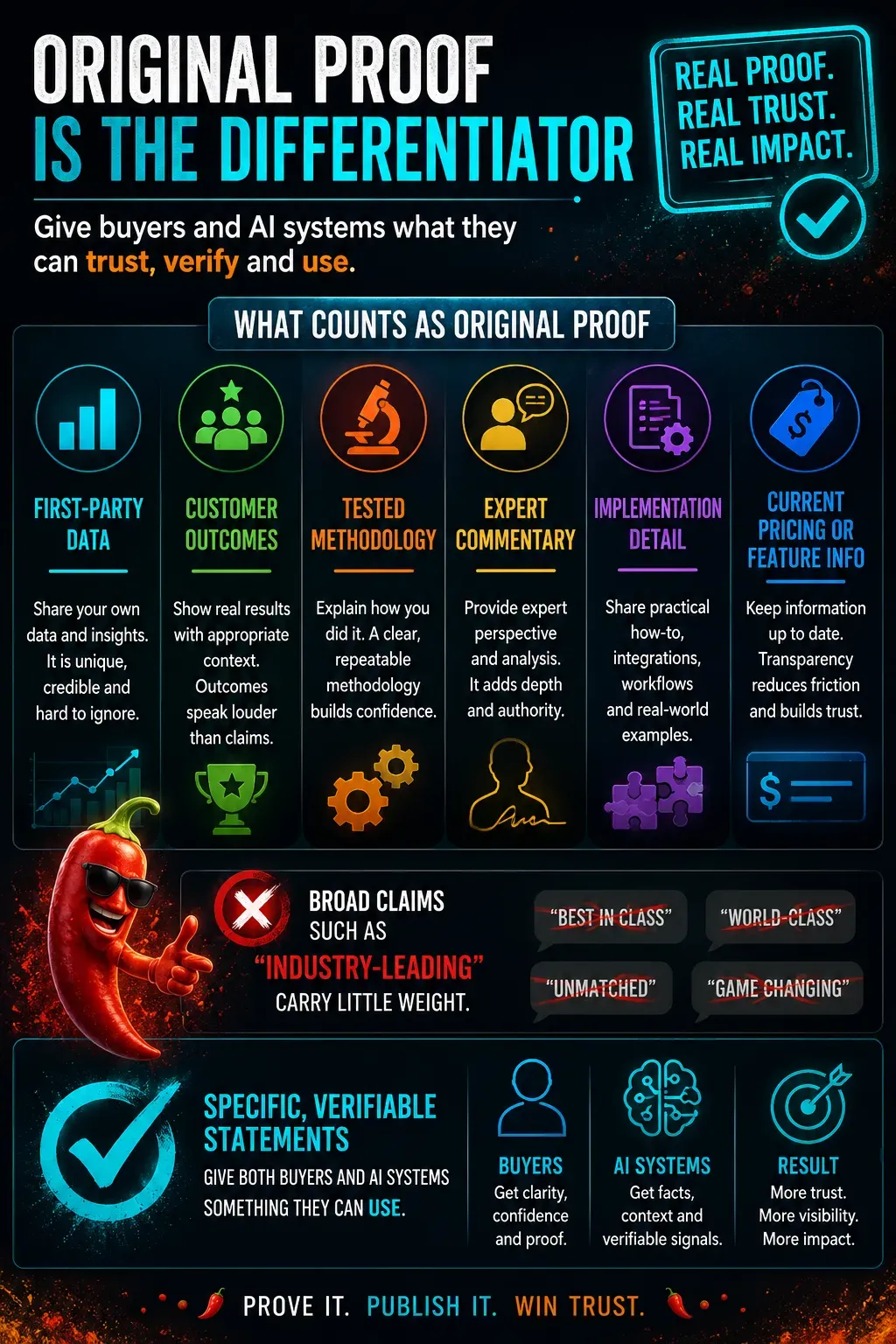
Original proof is the differentiator. Publish first-party data, customer outcomes with appropriate context, tested methodology, expert commentary, implementation detail and current pricing or feature information. Broad claims such as “industry-leading” carry little weight. Specific, verifiable statements give both buyers and AI systems something they can use.
Structure content for extraction, not just scanning
Clear structure helps machines and humans reach the point quickly. Use descriptive headings, direct opening answers, explanatory body copy and meaningful tables where comparison is genuinely required. Put key definitions near the top of a page. Explain acronyms. Attribute statistics. Keep dates current.
Schema can reinforce your content’s meaning, especially for organisations, products, FAQs, reviews and articles. It is not a shortcut to an AI citation, and adding markup to thin content will not rescue it. Treat technical implementation as support for strong information, not a substitute for it.
AI overview optimisation guide: measure the signals that matter
Traditional rankings remain valuable, but they do not show whether an AI answer mentions your brand, cites your domain or recommends a competitor. The new scorecard needs to connect visibility with action.
Track these signals across a consistent prompt set:
- Brand mention rate: how often your brand appears in an AI-generated response for priority questions.
- Citation rate: how often your owned content is selected as a supporting source.
- AI share of voice: your visibility relative to named competitors across the same prompts.
- Sentiment and recommendation position: whether the response frames your brand positively, neutrally or negatively, and whether it is presented as a leading option.
- Platform variance: performance across Google AI Overviews, ChatGPT, Claude, Gemini and Perplexity, where source selection and answer behaviour differ.
These metrics expose problems that traffic data can hide. You may have strong organic rankings yet low citation rates because your pages are too promotional or lack specific evidence. You may be cited frequently but rarely named, suggesting that your content informs the answer while competitors own the category association. Or a competitor may suddenly gain share of voice after publishing a comparison asset, refreshing documentation or earning authoritative third-party coverage.
This is why monitoring must lead to a prioritised roadmap. A useful platform does not just show that visibility changed. It identifies the queries behind the movement, the competitors gaining ground and the content actions most likely to close the gap. aigeo insights turns that intelligence into practical tasks, so growth teams can decide what to create, update, structure or distribute next.
Fix the gaps with the highest commercial impact
Not every missing mention deserves a new content project. Prioritise opportunities using three filters: buyer intent, current competitive gap and your ability to provide a better source. A high-intent comparison query where your brand is absent but competitors are repeatedly mentioned should move faster than a broad informational topic with no path to pipeline.
When a gap is identified, diagnose it before writing. If AI systems misunderstand your offer, improve entity clarity across core pages and authoritative profiles. If they cite competitors for a feature comparison, build a factual comparison resource with transparent criteria. If your brand is recommended but the answer repeats outdated pricing or positioning, update the source pages and remove conflicting material.
Distribution still matters. Generative systems draw from a wider information environment than your website alone. Credible editorial coverage, partner pages, expert contributions, customer reviews and industry references can strengthen brand association. The trade-off is control: third-party mention can build trust, but you cannot dictate every word. Focus on accurate, durable information rather than chasing low-quality placements.
Avoid the optimisation traps
Keyword stuffing, fabricated FAQs and pages written only to mimic an AI answer are short-term tactics with limited value. They make content less useful and can damage the trust signals you are trying to build. The target is not to sound like a machine. The target is to become a credible source a machine can confidently use.
Avoid treating one AI Overview screenshot as proof of success or failure. Results can change by device, query wording, user context and time. Look for patterns across a meaningful set of commercially relevant prompts. Equally, do not abandon conventional SEO. Strong crawlability, useful content, technical hygiene and authority still underpin discoverability. GEO extends that foundation into the answer layer.
The brands that win will not publish more noise. They will build a measurement loop: monitor the questions that matter, identify where competitors own the answer, improve the evidence available to AI systems, and measure the change. Every useful page, citation and accurate mention strengthens your position in the answer economy. Start with the questions your buyers are already asking, then make it easy for AI to recognise your brand as part of the answer.
Related Posts
- Generative Search Content Optimisation Guide
This generative search content optimisation guide shows Australian marketing teams how to earn AI citations, lift share of voice and…
Read more about Generative Search Content Optimisation Guide - LLM Analytics Review for Brands That Want Visibility
An LLM analytics review for marketers: assess AI visibility, citations, sentiment and competitors, then turn data into actions that grow…
Read more about LLM Analytics Review for Brands That Want Visibility - 9 best generative engine optimisation tools
Compare the best generative engine optimisation tools for tracking AI visibility, citations, sentiment, and competitor share of voice.
Read more about 9 best generative engine optimisation tools