
Your competitors can outrank you without ranking above you.
That is the shift most teams still underestimate. Competitor tracking in generative search is no longer a nice extra for SEO reporting – it is how brands see who is actually winning inside ChatGPT, Gemini, Perplexity, Claude, and Google AI Overviews. If your market is moving from ten blue links to AI-generated answers, then your competitor set is now being decided by which brands the models mention, cite, and trust.
This matters because generative search changes the shape of visibility. A brand can have strong organic rankings and still disappear in AI answers. Another can have modest traditional SEO performance and suddenly show up everywhere because its content is easier to cite, its brand is clearer, or its authority signals are stronger across the web. The result is simple: if you are only tracking rankings, you are tracking the wrong battlefield.
What competitor tracking in generative search actually measures
Traditional competitor analysis focused on keyword overlap, rankings, backlinks, and paid activity. Useful, yes. Sufficient, no. Generative engines do not just rank pages. They assemble answers. That means your competitors are not only the brands beside you on Google page one. They are the brands an AI system chooses to mention when a buyer asks for recommendations, comparisons, pricing guidance, implementation advice, or supplier shortlists.
Competitor tracking in generative search measures that answer-layer competition. It looks at how often your brand appears versus named competitors, how often those mentions are supported by citations, the sentiment attached to those mentions, and how performance changes by platform and prompt category.This is where many teams get caught out. They assume visibility is one metric. It is not. Mention frequency tells you whether you are in the conversation. Citation rate shows whether the model can anchor claims about your brand to discoverable sources. AI share of voice reveals how much of the recommendation space your brand controls. Sentiment indicates whether you are being surfaced positively, neutrally, or with risk attached. Each metric tells a different commercial story.
Why AI visibility is a competitor problem first
Most marketers approach GEO as a content problem. Partly true. But the sharper lens is competitive positioning.
AI engines do not generate answers in a vacuum. They choose from an available field of sources and brands. When a model recommends a competitor instead of you, that is not just a visibility gap. It is a demand capture problem. It can influence who gets considered, shortlisted, and contacted before a buyer ever reaches a search results page.
That is why competitor tracking needs to move beyond vanity monitoring. You need to know where rivals are gaining ground, on which platforms they perform best, and what content patterns correlate with their visibility. A competitor might dominate Perplexity because it cites structured comparison pages. Another might win in Google AI Overviews because its informational content is clearer and more authoritative. Another may perform well in ChatGPT because its brand is consistently referenced across trusted third-party sources.
The trade-off here is important. Generative engines do not behave identically, so there is no single benchmark that explains everything. A brand leading in one environment may be invisible in another. Smart tracking separates platform-specific performance instead of flattening it into one blended score.
The signals that show why a competitor is beating you
When a competitor gains AI visibility, teams often jump straight to content production. That can work, but it can also create more noise if you have not diagnosed the actual reason they are winning.
Sometimes the issue is coverage. Your competitor has content for more of the commercial and informational prompts that matter. Sometimes it is structure. Their pages answer questions directly, use stronger semantic cues, and make extraction easier for AI systems. Sometimes it is distribution. Their brand is discussed more often across publisher sites, directories, reviews, and expert roundups. And sometimes it is trust. The model sees more corroborating evidence for their claims than yours.
That is why good competitor tracking should show more than who appears. It should reveal the likely drivers of that visibility. If a rival has a high mention rate but weak citation support, their lead may be shallow and easier to disrupt. If they have both strong mention frequency and strong citations across multiple engines, they are building durable answer-market share.
This is where metric-led GEO becomes commercially useful. The point is not to admire the leaderboard. The point is to identify what changed, what content or source type is contributing to the shift, and what action gives you the fastest route back into the answer.
How to track competitors without creating another reporting mess
The biggest failure mode is obvious: teams add AI visibility to an already bloated reporting stack and end up with more dashboards, more screenshots, and less clarity.
Effective competitor tracking in generative search needs a tighter operating model. Start with a controlled competitor set, not every brand in the category. Track the brands that genuinely compete for the same buyers, the same high-intent prompts, and the same AI recommendation scenarios. Then segment prompts by intent. Informational prompts tell you who is shaping category understanding. Commercial and comparison prompts tell you who is influencing pipeline.
From there, focus on a handful of metrics that map to action. Mention share shows relative presence. Citation rate indicates source trust and extractability. Sentiment helps identify reputational drag or strength. Platform breakdowns reveal where you are losing. Prompt-level analysis tells you whether the issue sits in top-of-funnel education or bottom-of-funnel buying moments.
The next step is where most tools fall short. Data alone does not change performance. You need the optimisation roadmap attached to the tracking layer. If a competitor is repeatedly cited for pricing transparency, create or improve that asset. If they dominate implementation questions, build clearer service pages, help content, or use-case explainers. If they are winning through third-party validation, your response may need digital PR, review strategy, or better distribution – not just on-site edits.
What good competitor intelligence looks like in practice
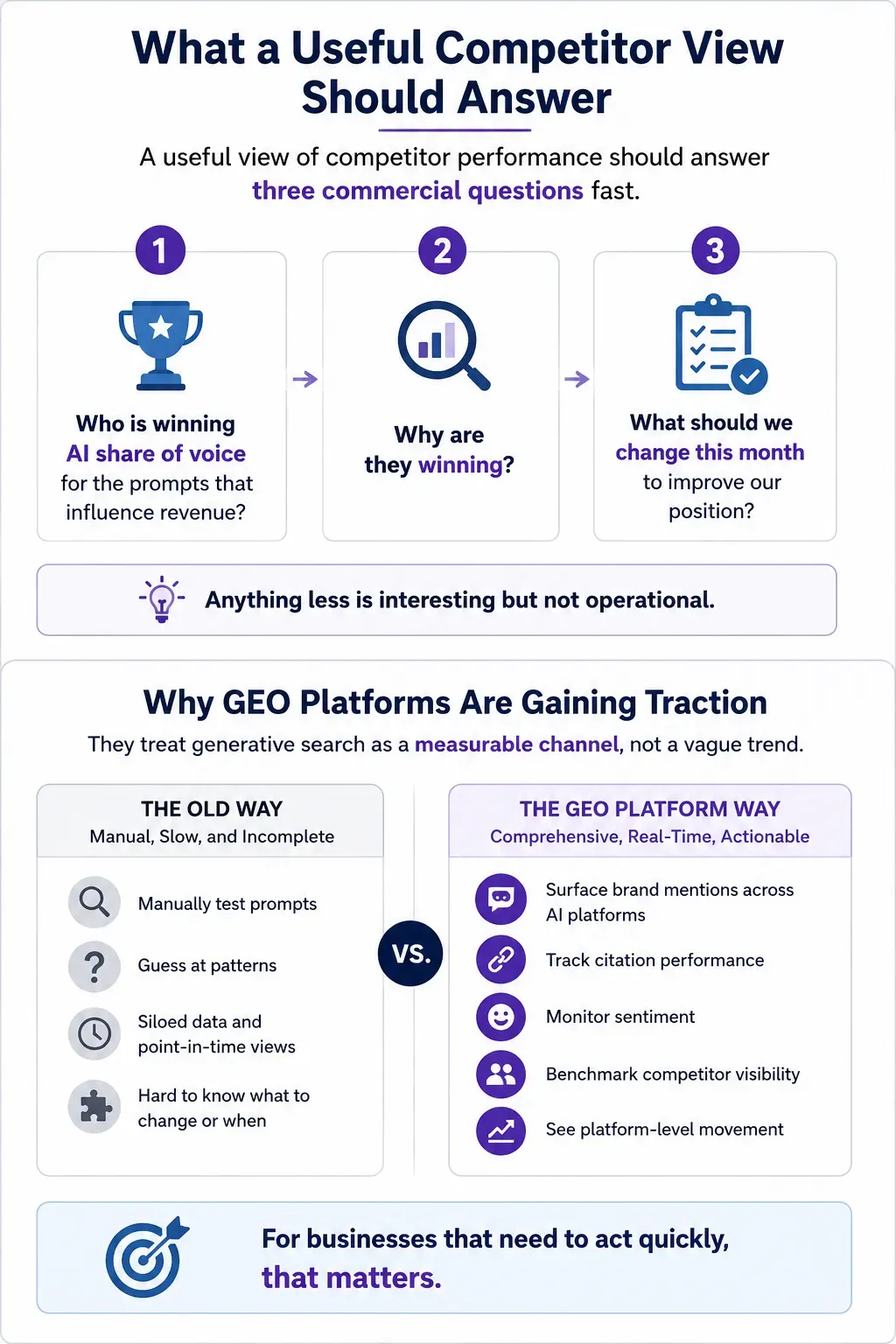
A useful view of competitor performance should answer three commercial questions fast.
First, who is winning AI share of voice for the prompts that influence revenue? Second, why are they winning? Third, what should we change this month to improve our position?
Anything less is interesting but not operational.
This is why platforms built for GEO are gaining traction. They treat generative search as a measurable channel, not a vague trend. Instead of asking teams to manually test prompts and guess at patterns, they surface brand mentions, citation performance, sentiment, competitor visibility, and platform-level movement in one place. For businesses that need to act quickly, that matters.
A system such as aigeo insights pushes this further by turning tracking into a dynamic optimisation roadmap. That is the real shift. Monitoring tells you where you are losing. Action planning tells you how to win the next round.

The common mistakes brands make
The first mistake is treating AI search like classic rank tracking with a new label. Ranking reports do not explain why an LLM chooses one brand over another.
The second is obsessing over mentions while ignoring citations. A mention without support can be fragile. A citation-backed presence is usually harder to displace.
The third is using one generic prompt set for every product, market, and buying stage. Competitor dynamics change depending on whether the user is researching, comparing, validating, or ready to buy.
The fourth is failing to connect visibility changes to real business outcomes. If your competitor is gaining AI share of voice on high-intent prompts, that should shape content priorities, brand messaging, and budget allocation. This is not a side report for the SEO team. It is market intelligence.
Where competitor tracking goes next
As generative search matures, the brands that win will not be the ones with the most content. They will be the ones with the clearest evidence, the strongest entity signals, the best-structured assets, and the fastest response loop when competitors gain ground.
That makes competitor tracking a frontline discipline. You are not just watching what rivals publish. You are watching how machines interpret credibility, relevance, and recommendation value across the market.
The battle for the answer has already begun. The brands that measure competitor visibility inside generative search early will have more than better reporting. They will have a clearer map of where demand is being captured, where authority is being assigned, and where the next move should land.
If your brand is not being named when buyers ask AI who to trust, the problem is no longer awareness alone. It is competitive absence – and absence is expensive.
Related Posts
- Generative Search Content Optimisation Guide
This generative search content optimisation guide shows Australian marketing teams how to earn AI citations, lift share of voice and…
Read more about Generative Search Content Optimisation Guide - Generative Search Strategy for Marketers
Build a generative search strategy for marketers that measures AI visibility, earns citations and turns competitive insights into practical, fast…
Read more about Generative Search Strategy for Marketers - What Affects AI Brand Mentions in AI Search?
Learn what affects AI brand mentions across ChatGPT, Gemini and Google AI Overviews, then turn visibility data into a sharper…
Read more about What Affects AI Brand Mentions in AI Search?