
Generative Search Reporting Templates That Win
Your brand can rank first for a commercial keyword and still disappear when a buyer asks ChatGPT, Gemini or Perplexity for a recommendation. That is the new visibility gap. Generative search reporting templates give growth teams a consistent way to measure that gap, show the commercial risk and direct action before competitors become the default answer.
Traditional SEO reports were built for a results page: rankings, clicks, impressions and backlinks. AI search requires a different operating view. The question is no longer only, “Where do we rank?” It is, “Does the model mention us, recommend us, cite our content accurately and position us ahead of competitors when purchase intent is high?”
Why generative search reporting needs a new structure
A monthly ranking report cannot explain whether an AI assistant names your company in a shortlist, presents stale claims about your offer or repeatedly cites a competitor’s comparison page. Those outcomes influence consideration well before a prospect reaches your site.
A useful report connects platform-level visibility to business decisions. It should reveal where brand presence is rising or slipping, which prompts create the greatest exposure, how competitors are being framed, and what the team needs to create, update or distribute next.
That means reporting needs both a scorecard and a plan. A scorecard alone creates interesting slides. A plan creates momentum.
Start with the questions buyers actually ask
Do not build a report around broad vanity prompts. Build it around the moments that move revenue: category discovery, product comparisons, use-case recommendations, alternative searches, implementation questions and reputation-sensitive queries.
For an Australian B2B software business, that might include prompts such as “best payroll software for Australian businesses”, “Xero alternatives for agencies” or “how to choose a CRM for a growing sales team”. The exact queries depend on your market, but the principle is fixed: track prompts with commercial consequences, not just high search volume.
Group these prompts by intent. This makes reporting easier to interpret. If your visibility falls in comparison prompts while remaining strong in informational prompts, the problem is not general awareness. It is consideration-stage positioning, and the response should be different.
The core generative search reporting template
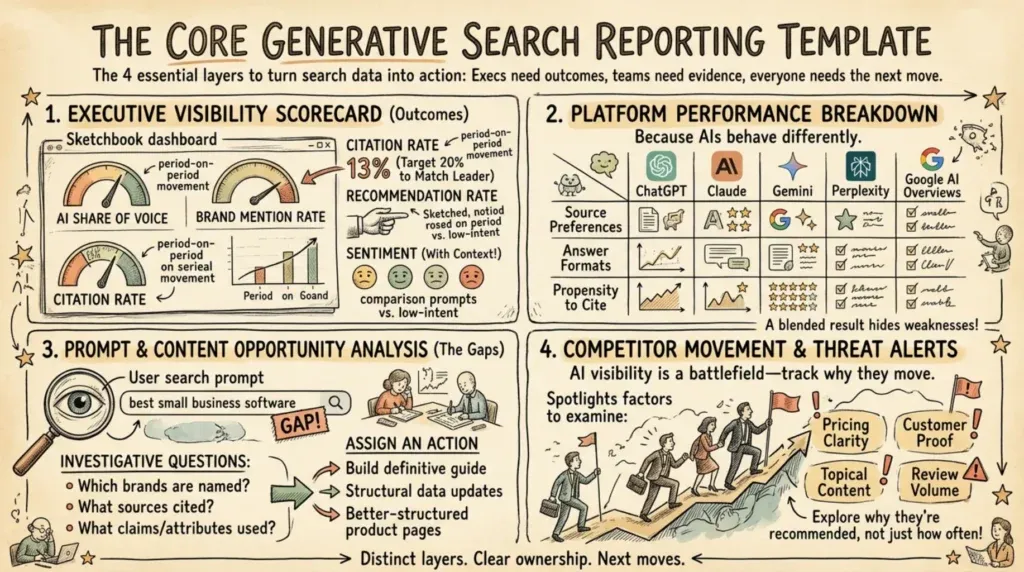
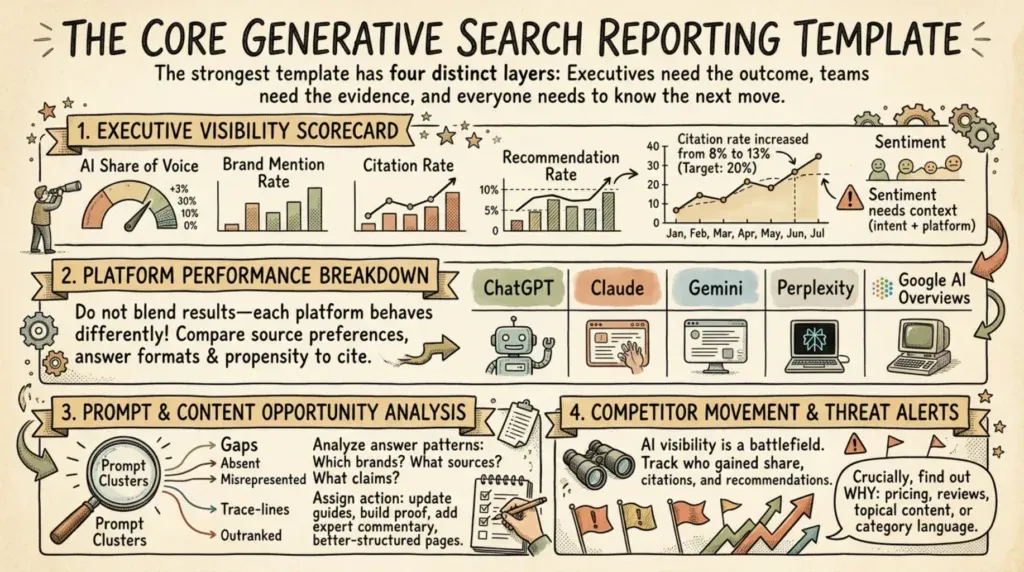
The strongest template has four layers: executive outcomes, visibility diagnostics, competitive intelligence and a prioritised action plan. Keep these layers distinct. Executives need the outcome. Search and content teams need the evidence. Everyone needs to know who owns the next move.
1. Executive visibility scorecard
Lead with the metrics that show whether the brand is winning space in AI-generated answers. For each reporting period, show AI share of voice, brand mention rate, citation rate, recommendation rate and sentiment.
AI share of voice measures how often your brand appears relative to competitors across your tracked prompt set. Mention rate tells you the percentage of responses that include the brand. Citation rate shows how often AI platforms reference your owned content or recognised third-party sources associated with your expertise. Recommendation rate isolates the prompts where the model actively suggests your brand, which is often more valuable than a passing mention.
Sentiment needs context. A positive mention in a low-intent educational answer may not outweigh a neutral or negative framing in high-value comparison prompts. Report sentiment alongside prompt intent and platform, rather than presenting one blended score that hides the risk.
Include period-on-period movement and a clear target for each metric. “Citation rate increased from 8% to 13%” is informative. “Citation rate increased from 8% to 13%, still below the 20% target needed to match the leading competitor” creates urgency.
2. Platform performance breakdown
ChatGPT, Claude, Gemini, Perplexity and Google AI Overviews do not behave identically. Their source preferences, answer formats and propensity to cite vary. A blended result can hide a major weakness on the platform your audience uses most.
Your reporting template should show each platform in a simple comparative view: mention frequency, citation rate, sentiment, share of voice and change since the previous period. Add a short interpretation below the numbers. For example, strong Perplexity citations may indicate that your source material is credible and accessible, while weak Gemini mentions could point to an entity, content coverage or competitive-authority gap.
Avoid declaring a platform winner based on one month of data. Generative systems change, prompt outputs vary and visibility can move quickly. Look for recurring patterns across a representative set of prompts before reallocating significant budget.
3. Prompt and content opportunity analysis
This is where a reporting template becomes commercially useful. Identify the prompts where the brand is absent, misrepresented or outranked by a competitor, then connect each gap to a content or distribution opportunity.
For every priority prompt cluster, record the current answer pattern. Which brands are named? What sources are cited? What claims or attributes does the AI use to justify its recommendation? Is the answer missing a useful category distinction that your content could clarify?
Then assign an action. A low citation rate may require a more definitive guide, clearer supporting evidence, expert commentary or better-structured product pages. A competitor winning “alternatives” prompts may require a fair comparison page that directly addresses buyer criteria. Negative sentiment may require correcting outdated third-party information, strengthening review coverage or publishing clearer documentation.
Do not treat every missing mention as a content brief. Some gaps are caused by weak brand authority, limited third-party validation or an unclear market position. The right action may be digital PR, partnership distribution, review generation or a product messaging fix. The report should say which.
4. Competitor movement and threat alerts
AI visibility is a competitive battlefield, so reporting must show movement rather than static snapshots. Track which competitors gained share of voice, increased recommendation frequency or secured citations for high-intent prompts.
The most valuable insight is not that a competitor appears more often. It is why. If they are repeatedly recommended for “best for small business” queries, examine the evidence in the answer: pricing clarity, customer proof, topical content, review volume or category language. This turns competitor monitoring into a practical benchmark instead of a monthly scoreboard.
Set alert thresholds for meaningful changes. A small swing across a broad prompt set may be noise. A competitor appearing for the first time in a cluster of high-conversion comparison queries deserves an immediate response. Your template should make that distinction obvious.
Make the report useful in the room
Reporting often fails because it is written for analysts, then presented to decision-makers who need a commercial answer. Open every report with three statements: what changed, why it matters and what happens next.
For example: “Our AI share of voice fell six points in enterprise comparison prompts after Competitor A gained citations from independent review pages. This puts late-stage demand at risk. This month, we will publish a decision-maker comparison asset, strengthen proof points across priority pages and secure third-party validation.”
That format gives leadership confidence that the team is not merely observing AI search change. It is responding to it.
Use owners and deadlines in the action section. A recommendation without an owner is commentary. Each action should include expected impact, effort level, responsible team and target date. This also lets you assess whether completed work changes visibility over time.
Reporting cadence: weekly signals, monthly decisions
The right cadence depends on your category and the scale of your tracked prompts. Fast-moving markets, agencies and brands under active competitive pressure benefit from weekly monitoring for material shifts. Most leadership teams need a monthly strategic report, with quarterly reviews for trend analysis and resource planning.
Weekly reporting should be lean: alerts, major movement and urgent actions. Monthly reporting should provide the full scorecard, platform analysis, competitor changes and roadmap. Quarterly reporting should answer tougher questions: Are we gaining durable presence? Which content investments drove citations? Are we improving on the prompts that influence pipeline?
Consistency matters more than report length. If the prompt set changes every month, trend lines become unreliable. Maintain a stable core set, then add campaign-specific or emerging prompts as a separate layer.
Ready to get started?
A one-line nudge that earns the click below.
Turn visibility data into a GEO roadmap
The battle for the answer has begun, and the brands that win will not be those with the prettiest dashboards. They will be the ones that turn evidence into repeatable action.
aigeo insights can bring this workflow together by tracking mentions, citations, sentiment, AI share of voice and competitor performance across major generative platforms, then translating the findings into prioritised optimisation work. Whether you use a dedicated platform or an internal reporting process, the standard should be the same: every report must make the next best action impossible to miss.
Your next report should not end with a chart. It should end with a decision that puts your brand closer to becoming the answer buyers see first.
Related Posts
- How to Prioritise Generative Search Tasks
Learn how to prioritise generative search tasks using visibility, citation and competitor data, so your team acts where AI search…
Read more about How to Prioritise Generative Search Tasks - Generative Search Audit Guide for AI Visibility
Use this generative search audit guide to measure AI visibility, expose competitor gaps, and turn citations, sentiment and share of…
Read more about Generative Search Audit Guide for AI Visibility - Generative Search Strategy for Marketers
Build a generative search strategy for marketers that measures AI visibility, earns citations and turns competitive insights into practical, fast…
Read more about Generative Search Strategy for Marketers