
A prospect asks an AI assistant which provider is best for their problem. The answer names three competitors, explains their strengths and cites their resources. Your brand does not appear. That is not a rankings problem alone. It is a revenue and reputation problem. To optimise content for answer engines, your team must create material AI systems can retrieve, trust, interpret and confidently use in a response.
Generative search has changed the unit of competition. You are no longer only competing for a blue link and a click. You are competing to become the cited source, recommended option or factual reference inside the answer itself. The brands that win will not publish more generic content. They will build an evidence-led content system that answers high-value questions better than anyone else.
Answer engines evaluate evidence, not just webpages
Traditional search optimisation is often centred on ranking a page for a query. Answer engines work differently. They retrieve information from multiple sources, assess relevance and credibility, then synthesise an answer. A page can rank well and still be ignored if its claims are vague, its structure is difficult to extract, or its information does not directly resolve the user’s question.
That does not mean conventional SEO is obsolete. Technical accessibility, authority and useful content still matter. But answer visibility introduces another layer: whether an AI model can identify your brand, understand what you offer, verify your claims and connect you with the right recommendation context.
For commercial teams, the most valuable questions are rarely broad definitions. They are prompts with purchase intent, such as “Which accounting platform is best for a growing Australian retailer?”, “What should I look for in a cyber security provider?” or “How do I compare enterprise payroll systems?” If your content only explains the category while competitors supply the criteria, proof and comparisons, they are far more likely to own the answer.
Start with the questions that move pipeline
Build a prompt map around the decisions your buyers actually make. Include discovery questions, comparison questions, implementation concerns, pricing objections and risk-related queries. Then separate them by audience. A CFO, marketing leader and operations manager may ask about the same product in entirely different language.
This is where many content plans fail. Teams target a keyword cluster, publish a handful of articles and assume coverage is complete. Answer engines respond to specific wording, context and constraints. “Best CRM for a small team” is not the same opportunity as “CRM with Australian support and HubSpot migration”. Both may matter, but they require different evidence.
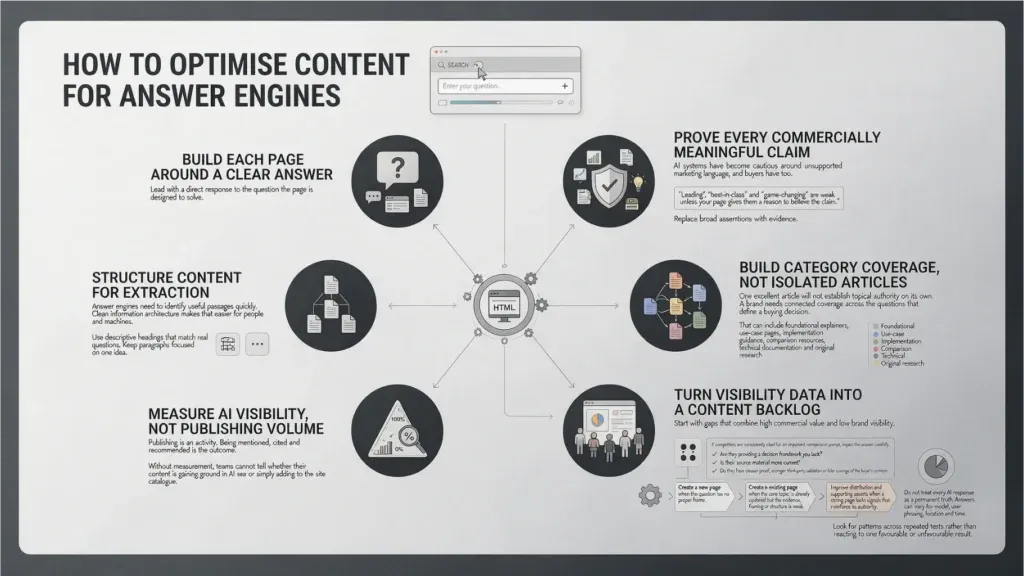
How to optimise content for answer engines
Build each page around a clear answer
Lead with a direct response to the question the page is designed to solve. The opening should state what the reader needs to know, who the guidance applies to and where the exceptions sit. Do not force a model or a buyer to scan 800 words of scene-setting before finding the point.
A strong page then expands the answer with definitions, decision criteria, examples and next steps. For a service page, explain the problem you solve, the process, outcomes, limitations and the type of customer you suit best. For a comparison page, make the comparison fair. Answer engines are less likely to trust content that reads like a disguised advertorial.
Be precise about entities. Use consistent names for your company, products, services, locations and specialists. If your brand calls a feature one thing on its website, another in help documentation and a third in media coverage, you create unnecessary ambiguity. Consistency helps systems connect the dots.
Prove every commercially meaningful claim
AI systems have become cautious around unsupported marketing language, and buyers have too. “Leading”, “best-in-class” and “game-changing” are weak unless your page gives them a reason to believe the claim.
Replace broad assertions with evidence: original research, clearly dated statistics, customer outcomes with context, methodology notes, product specifications, expert commentary and transparent limitations. If you say a platform reduces reporting time, explain for whom, under what workflow and how the result was measured.
This is not about stuffing pages with numbers. It is about making the information verifiable. A concise benchmark with a defined sample is more useful than an impressive statistic with no source or timeframe. When facts change, update them. Outdated pricing, product details or regulatory guidance can reduce trust far beyond one page.
SEE IT FIRST
Book a 20-minute walkthrough.
A real person, a shared screen, and zero pressure. Walk away with the answers you came for.
Structure content for extraction
Answer engines need to identify useful passages quickly. Clean information architecture makes that easier for people and machines.
Use descriptive headings that match real questions. Keep paragraphs focused on one idea. Put definitions near the start, use tables where readers genuinely need to compare options, and label charts or visuals with meaningful text. Avoid burying essential qualifications in accordions, image-only graphics or downloadable PDFs.
For high-value pages, include these distinct information blocks:
- A plain-language answer or definition
- The criteria used to evaluate options or make a decision
- Evidence, examples or data that support the guidance
- Clear limitations, edge cases and who the advice may not suit
The last point is often overlooked. Content that acknowledges trade-offs sounds more credible because it is more useful. A lower-cost tool may suit a small team but lack the controls an enterprise needs. Say so. Honest boundaries help both buyers and answer engines understand when your brand is the right fit.
Build category coverage, not isolated articles
One excellent article will not establish topical authority on its own. A brand needs connected coverage across the questions that define a buying decision. That can include foundational explainers, use-case pages, implementation guidance, comparison resources, technical documentation and original research.
The objective is not to repeat the same answer in ten formats. It is to give each page a distinct job. A glossary entry might explain what AI share of voice means. A benchmark report can show where a category is moving. A product page can explain how your solution addresses the issue. A comparison page can help a buyer choose.
Prioritise depth where money changes hands. If a topic generates awareness but no qualified demand, it may deserve a lighter asset. If a prompt repeatedly appears in sales calls or influences shortlisting, it deserves authoritative coverage and regular maintenance.
Measure AI visibility, not publishing volume
Publishing is an activity. Being mentioned, cited and recommended is the outcome. Without measurement, teams cannot tell whether their content is gaining ground in AI search or simply adding to the site catalogue.
Track performance across a controlled set of commercial prompts and the platforms your audience uses. Monitor brand mention frequency, citation rate, AI share of voice, sentiment, competitor inclusion and the specific pages or sources that appear to influence responses. Break results down by topic, funnel stage and platform. A strong presence in Google AI Overviews does not guarantee equal visibility in ChatGPT, Claude, Gemini or Perplexity.
This is where a platform such as aigeo insights turns an emerging search problem into an operating system. The valuable output is not another dashboard. It is a prioritised roadmap showing which prompts are slipping, which competitors are gaining visibility, and which pages should be created, improved or reinforced with evidence.
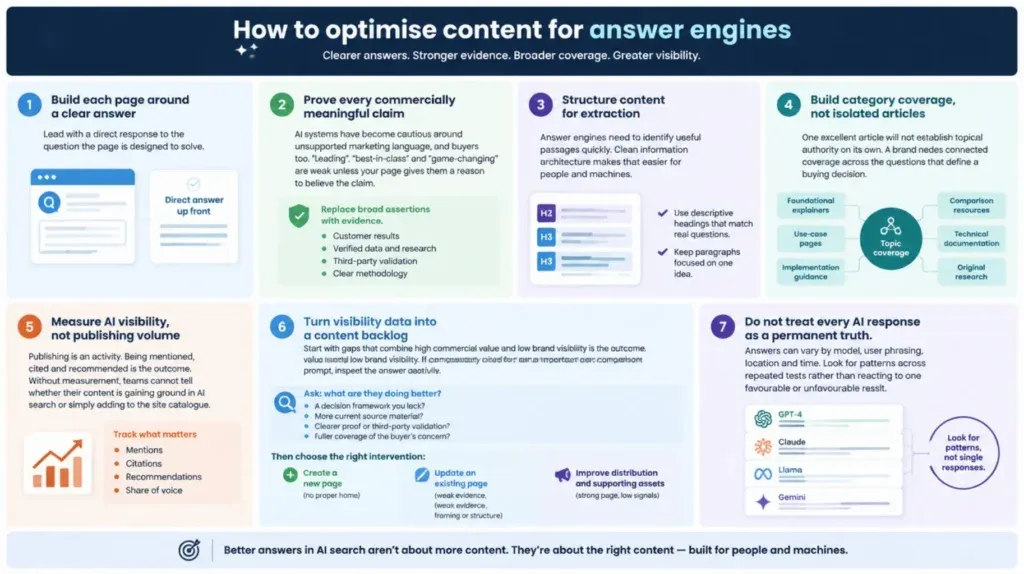
Turn visibility data into a content backlog
Start with gaps that combine high commercial value and low brand visibility. If competitors are consistently cited for an important comparison prompt, inspect the answer carefully. Are they providing a decision framework you lack? Is their source material more current? Do they have clearer proof, stronger third-party validation or fuller coverage of the buyer’s concern?
Then choose the right intervention. Create a new page when the question has no proper home. Update an existing page when the core topic is already covered but the evidence, framing or structure is weak. Improve distribution and supporting assets when a strong page lacks signals that reinforce its authority.
Do not treat every AI response as a permanent truth. Answers can vary by model, user phrasing, location and time. Look for patterns across repeated tests rather than reacting to one favourable or unfavourable result.
The mistakes that cost brands citations
The first mistake is publishing content designed to sound impressive rather than answer a question. Fluffy intros, undefined claims and generic advice create little value for a reader and little usable material for an answer engine.
The second is treating brand visibility as a technical SEO issue only. Crawlability matters, but a perfectly accessible page with no distinctive evidence will struggle to become a preferred source. Your subject-matter expertise, customer insight and proof are the advantage.
The third is measuring rankings while ignoring representation. A brand can appear in AI answers with negative sentiment, incomplete positioning or a competitor framed as the better option. Visibility without context is not a win.
The battle for the answer has begun, but the practical response is straightforward: make your expertise easier to verify, your pages easier to extract and your performance impossible to ignore. Every high-intent question your brand answers well today is a position a competitor has less chance to claim tomorrow.
Related Posts
- Answer Engines Are Reshaping Brand Discovery
Answer engines are changing how Australians discover, compare and trust brands. Learn what to measure and how to earn visibility…
Read more about Answer Engines Are Reshaping Brand Discovery - Citation Sources for AI Answers That Win
Learn which citation sources for AI answers shape brand visibility, how models select them, and how to build content that…
Read more about Citation Sources for AI Answers That Win - 7 Best Content Formats for Chatbots That Get Cited
Learn which best content formats for chatbots earn AI citations, shape recommendations and help your brand win visibility across generative…
Read more about 7 Best Content Formats for Chatbots That Get Cited