
GEO is fundamentally linked to traditional SEO! Why? LLMs search the web to help produce most responses. To be absolutely clear, AI search does not simply rank a page and send a click. It interprets a question, selects evidence, forms an answer and decides which brands deserve a mention. A generative search strategy for marketers is the operating plan for winning that decision across ChatGPT, Gemini, Claude, Perplexity and Google AI Overviews.
The stakes are commercial. When a buyer asks an AI platform for the best project management software, financial adviser, skincare routine or B2B supplier, the brands included in the response begin the shortlist with an advantage. Brands left out may never get the chance to compete. The battle for the answer has begun.
What a generative search strategy for marketers must do
Traditional SEO remains valuable. People still search, compare results and visit websites. But ranking in a results page is no longer the full job. Generative engines synthesise information from multiple sources, often without presenting a familiar list of ten blue links.
Your strategy must therefore manage visibility at the answer level:
• AI share of voice
• Owned content is cited
• High-value prompts
• Monitor sentiment and competitor data
That means measuring more than keyword positions. Marketing teams need to know how often their brand is mentioned for high-value prompts, whether those mentions are positive, whether their owned content is cited, and which competitors appear alongside them. This is AI share of voice: your presence in the answers shaping buyer perception.
A useful strategy connects four disciplines: audience demand, credible content, technical accessibility and continuous measurement. Miss one and the programme becomes guesswork. Publish plenty of content without tracking AI responses, and you cannot tell what changed. Monitor every platform without improving the source material, and you have built a dashboard rather than a growth system.
Start with the questions that create revenue
Do not begin by trying to appear for every possible prompt. Start where an AI recommendation, comparison or explanation can influence pipeline, sales or reputation.
Map questions across the customer journey. Early-stage prompts often ask for definitions and frameworks, such as “what is generative engine optimisation?” Mid-funnel prompts compare approaches, vendors and prices. Late-stage prompts ask for alternatives, implementation requirements, integrations, use cases and proof that a provider can deliver.
The most valuable prompts are usually specific enough to show intent but broad enough to recur across your market. For a SaaS business, this might include “best AI visibility tracking tools”, “how to measure brand mentions in ChatGPT” or “GEO software for agencies”. For a local service business, it may be recommendation queries tied to location, category and customer need.
Prioritise prompts using business value, current visibility and competitive pressure. A prompt with modest search volume can still be critical if it appears just before a buying decision. Conversely, a broad educational question may build authority but produce little direct commercial impact. Both have a role, but they should not receive the same investment.
Build source material an AI can trust
Generative engines need clear, corroborated and useful information. They do not reward vague brand claims simply because those claims appear repeatedly on a company website. If your positioning is hard to verify, your content is thin, or every page says roughly the same thing, you give AI little reason to use you as evidence.
Create assets that answer one meaningful question thoroughly. Explain the problem, define the terms, show the method, state where the method does not apply and support important claims with original evidence where possible. A practical comparison page, implementation guide, product documentation hub or research-led benchmark can be more citation-worthy than another generic blog post.
Structure matters because it reduces ambiguity. Use descriptive headings, direct answers near the top of a section, consistent terminology and plain-language explanations. Add tables when readers genuinely need to compare options, but do not turn every page into a schema exercise. Mark-up can help machines interpret content; it cannot rescue content with no distinct point of view or proof.
Your owned site is only part of the evidence environment. AI answers can be influenced by respected publications, specialist communities, review sites, partner resources and authoritative third-party commentary. A credible distribution strategy helps establish the external signals that make your claims easier to believe. The goal is not to scatter the same article everywhere. It is to earn relevant, accurate references in the places your market already trusts.
Track the metrics that reveal answer-level performance
Web traffic alone will not show whether your brand is winning in generative search. An AI answer may influence a buyer long before they visit your site, and some responses cite sources while others simply name brands. You need a repeatable prompt set and a measurement baseline across platforms.
Track brand mention frequency, citation rate, AI share of voice, sentiment and competitor visibility. Break results down by platform, topic, funnel stage and market segment. A brand can be prominent in Perplexity but nearly absent from Google AI Overviews, or frequently mentioned in educational prompts while losing every vendor comparison. Those are different problems with different fixes.
Sentiment deserves particular attention. Being named in an answer is not a win if the surrounding language frames your product as expensive, limited or difficult to implement. Review the actual response, not just the count. AI models can also surface outdated positioning, old pricing or legacy product descriptions, exposing a reputation issue that conventional rank tracking may never reveal.
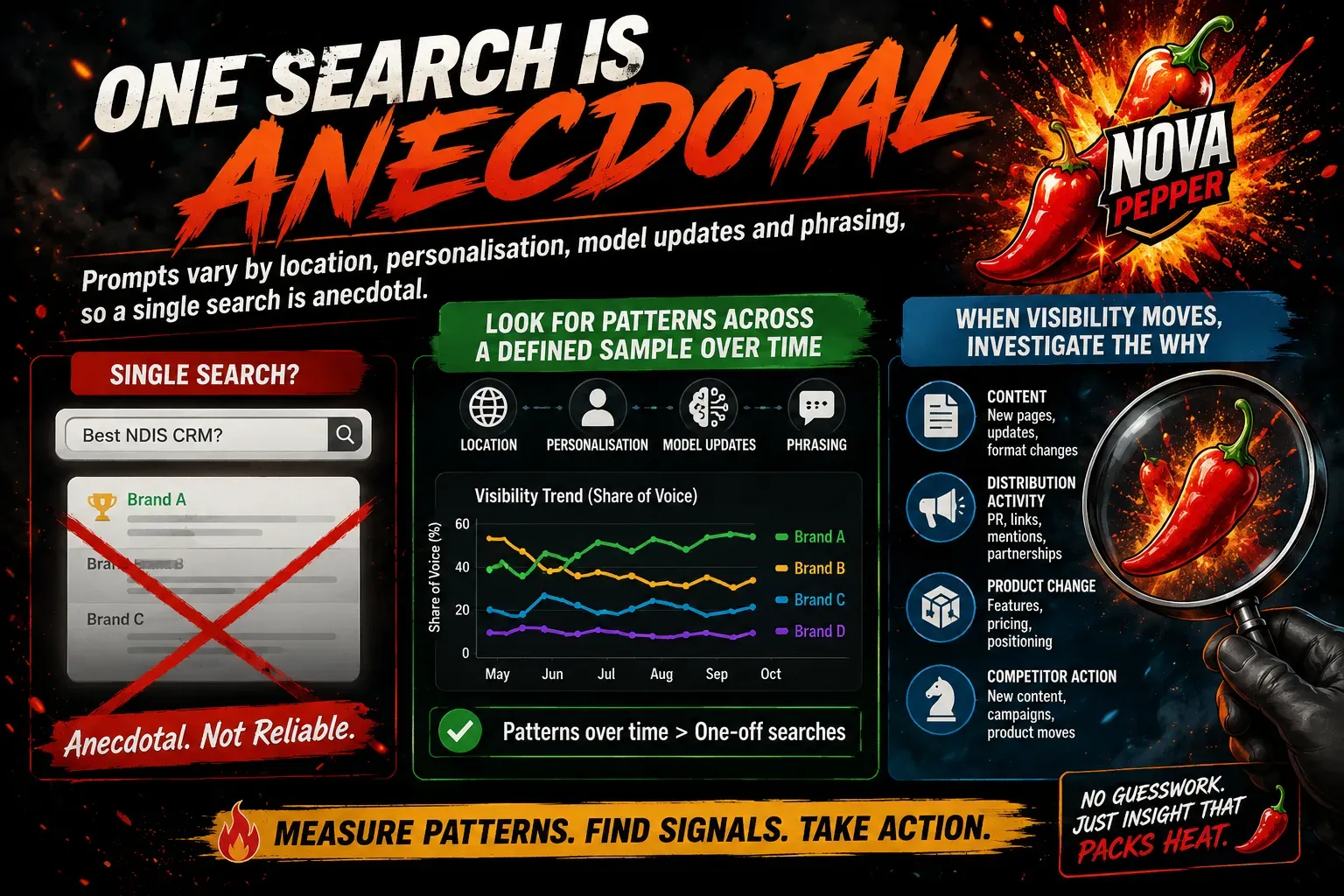
Use a consistent testing cadence. Prompts vary by location, personalisation, model updates and phrasing, so a single search is anecdotal. Look for patterns across a defined sample over time. When visibility moves, investigate which content, distribution activity, product change or competitor action may explain it.
Turn visibility gaps into an optimisation backlog
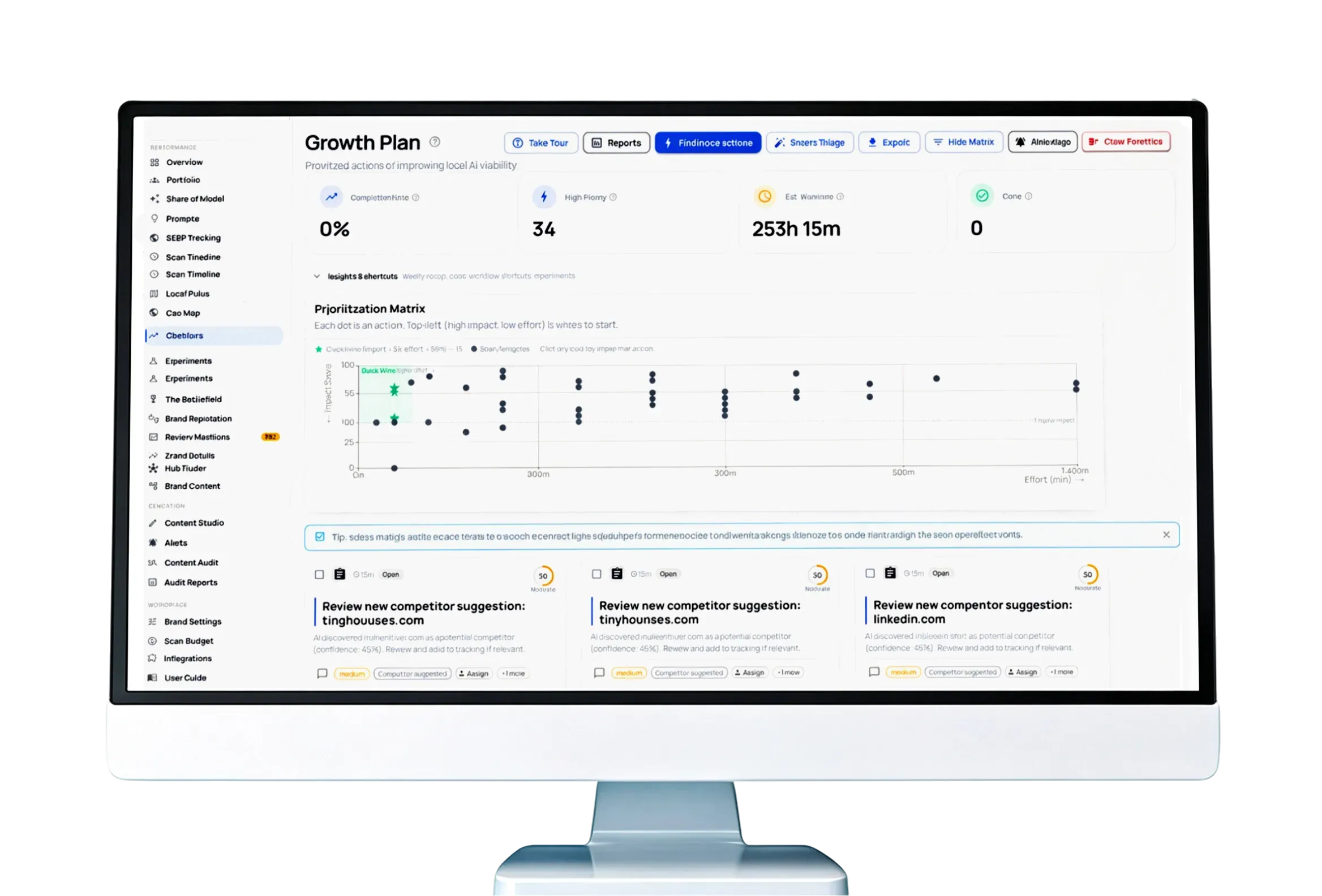
The difference between reporting and strategy is action. Every visibility gap should become a prioritised task with an owner, expected outcome and review date.
If competitors dominate “best” and “alternatives” prompts, assess whether your comparison content is missing, unconvincing or poorly supported by third-party proof. If your brand is mentioned but your pages are not cited, improve the depth and clarity of the most relevant owned resource. If AI describes the business inaccurately, update source pages, documentation and external profiles that may be supplying stale information.
Avoid the temptation to react to every fluctuation. Generative search is volatile, and models do not disclose a simple ranking formula. Focus on changes that repeat across priority prompts or materially affect high-intent categories. This is where a task-scored roadmap earns its place: it directs limited marketing resources towards the work most likely to increase visibility and commercial relevance.
For teams managing multiple brands, markets or clients, operational discipline matters as much as insight. Set a monthly review for strategic trends and a faster cadence for reputation-sensitive categories. Bring SEO, content, PR, product marketing and customer teams into the same conversation. AI representation is rarely fixed by one channel alone.
Balance GEO with the channels you already own
Generative Engine Optimisation is not a replacement for SEO, paid media, brand building or conversion-rate optimisation. It changes how those disciplines connect. Strong technical SEO makes content discoverable and usable. Brand marketing creates the recognition that makes a recommendation more persuasive. PR and partnerships expand credible evidence. Product marketing supplies the precise claims, use cases and proof that answer engines need.
The trade-off is focus. Chasing every AI platform, prompt variation and content format can drain a lean team. Start with the platforms your customers use and the questions that affect revenue. Expand only after you can measure a baseline and consistently turn findings into improvements.
This is why platforms such as sentimentstack from aigeo insights matter: the value is not merely seeing whether a brand appears in AI responses. It is translating mention, citation, sentiment and competitor data into the next content, technical or distribution action.
Your next buyer may not begin with a search result. They may begin with an answer that names three companies and quietly excludes yours. Treat that moment as measurable, improvable and worth competing for.
Related Posts
- Generative Search Content Optimisation Guide
This generative search content optimisation guide shows Australian marketing teams how to earn AI citations, lift share of voice and…
Read more about Generative Search Content Optimisation Guide - What Affects AI Brand Mentions in AI Search?
Learn what affects AI brand mentions across ChatGPT, Gemini and Google AI Overviews, then turn visibility data into a sharper…
Read more about What Affects AI Brand Mentions in AI Search? - GEO Versus SEO Strategy for Modern AI Search
Compare GEO versus SEO strategy, learn what each measures, and build a visibility plan that earns rankings, citations and AI…
Read more about GEO Versus SEO Strategy for Modern AI Search