




A GEO versus SEO strategy is now a boardroom issue, not a channel debate. A prospect can still search Google, compare organic results and visit your site. Or they can ask ChatGPT, Gemini, Claude or Perplexity for the best provider and receive a short list before a search results page ever enters the picture. If your brand is absent, misrepresented or outranked by a competitor in that answer, traditional rankings alone will not save the opportunity.
The battle for discoverability has expanded. SEO remains essential because search engines still drive high-intent traffic, support category authority and supply much of the source material AI systems draw on. GEO adds the missing operating layer: measuring and improving whether generative engines mention, cite and recommend your brand when buyers ask the questions that matter.
GEO versus SEO strategy: the real difference
SEO, or search engine optimisation, is designed to earn visibility in ranked search results. Its core performance signals include organic positions, impressions, clicks, traffic, conversions, backlinks and technical health. The question SEO answers is straightforward: can your page appear when someone searches a relevant query?
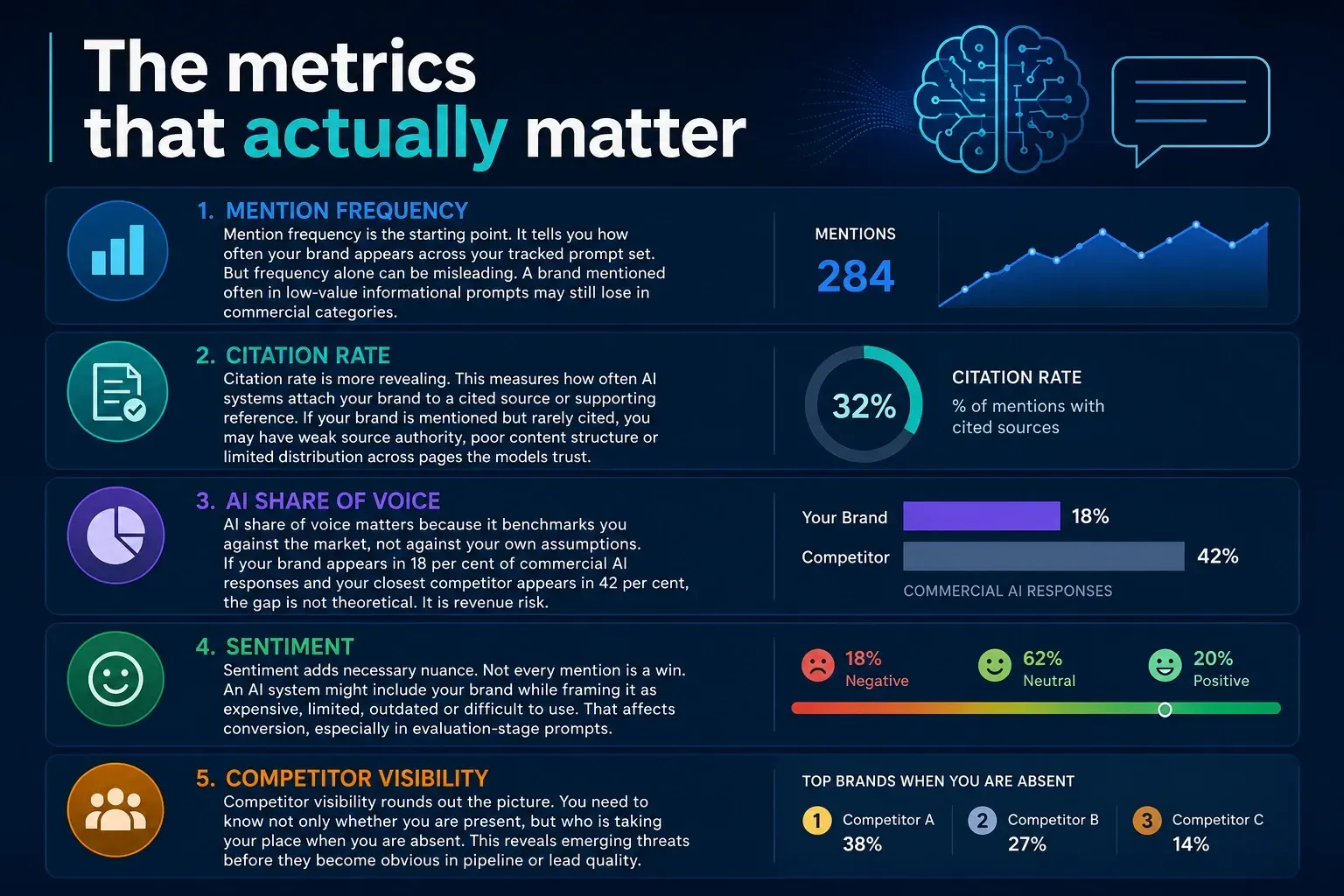
GEO, or Generative Engine Optimisation, is designed to earn visibility inside generated answers. It tracks signals such as brand mention frequency, citation rate, AI share of voice, sentiment, competitor presence and performance by platform. The question GEO answers is more commercially direct: when a buyer asks an AI for advice, does your brand become part of the answer?
That distinction changes the unit of competition. In conventional search, ten blue links can share attention. In generative search, the response may cite only a handful of sources and recommend just two or three companies. Being on page one is useful. Being the brand named in the answer is stronger.
SEO is largely page and keyword led. GEO is prompt, entity and answer led. An SEO team may track whether a service page ranks for “best payroll software Australia”. A GEO team also tracks what happens when people ask, “Which payroll platforms suit a growing Australian business?”, “What are the best alternatives to X?” or “Which provider has the strongest compliance support?” These prompts carry commercial intent, but do not always map neatly to a single keyword.
Why high rankings do not guarantee AI visibility
A strong organic ranking is an advantage, not a guarantee of citation. Generative engines synthesise information from multiple sources, assess entity relationships and may favour content that answers a narrow question clearly, corroborates claims and is easy to extract. A well-ranked landing page can lose out to a detailed guide, an independent review, an industry publication or a competitor with more consistent third-party coverage.
AI systems also do not behave identically. Google AI Overviews may surface a different source set from Perplexity. ChatGPT may mention brands based on a different mix of web evidence and contextual relevance than Gemini or Claude. Treating AI search as one channel creates false confidence. A brand can lead on one platform while disappearing on another.
Representation matters as much as visibility. A mention with incorrect pricing, outdated positioning or negative framing can damage consideration. SEO reporting often shows that a page was clicked. GEO reporting needs to show how the brand was described, whether it was cited, which competitors were recommended beside it and where the narrative is moving.
What SEO still owns
The idea that GEO replaces SEO is wrong and costly. Search optimisation remains the foundation for technical accessibility, crawlable content, search demand capture and durable owned authority. If your site is thin, slow, poorly structured or vague about what you do, GEO has less credible material to work with.
SEO is especially valuable when users know what they want and are actively comparing options through search. Product pages, local service pages, category pages, documentation and transactional content still need to rank, load quickly and convert. Organic search also offers clearer click-level attribution than many AI environments, where an answer may influence a decision without producing an immediate referral.
The trade-off is that SEO metrics can create a dangerous blind spot. Traffic may look healthy while AI platforms increasingly shape the shortlist upstream. If buyers ask an AI which vendors to consider, then search only for the names it provides, visibility in that first answer becomes a demand-generation asset.
What GEO adds to your growth system
GEO turns AI visibility from anecdote into an operating metric. Instead of checking a few prompts manually and hoping for the best, teams need repeatable monitoring across priority questions, competitors and platforms. They need to know where they appear, what sources earn citations and which gaps create an opening for rivals.
A practical GEO programme starts with the buyer questions that influence revenue. These include category discovery prompts, problem-led questions, comparison requests, use-case queries, alternative searches and trust questions about price, security, integrations or support. The aim is not to chase every possible prompt. It is to own the answer paths closest to consideration.
From there, content work becomes more precise. You may need to update an old guide that answers a common question incompletely, build a comparison page that explains genuine differences, strengthen evidence around claims, publish expert commentary, or distribute credible information where AI systems can encounter and validate it. The work is not about stuffing phrases into copy. It is about making your brand easy to understand, verify and cite.
The metrics that matter in generative search
Track AI share of voice to understand how often your brand appears against competitors across a defined prompt set. Track mention frequency to identify broad visibility. Track citation rate to see whether platforms use your owned content as evidence rather than merely naming your company. Then layer in sentiment and message accuracy, because a high-volume mention is not a win if the answer frames your business poorly.
Platform-level reporting is essential. A flat average can hide a serious weakness. For example, you may be highly visible in Google AI Overviews but absent in Perplexity for research-led comparisons, or frequently mentioned by ChatGPT but rarely cited. Each pattern points to a different action.
How to combine GEO and SEO without creating two siloed teams
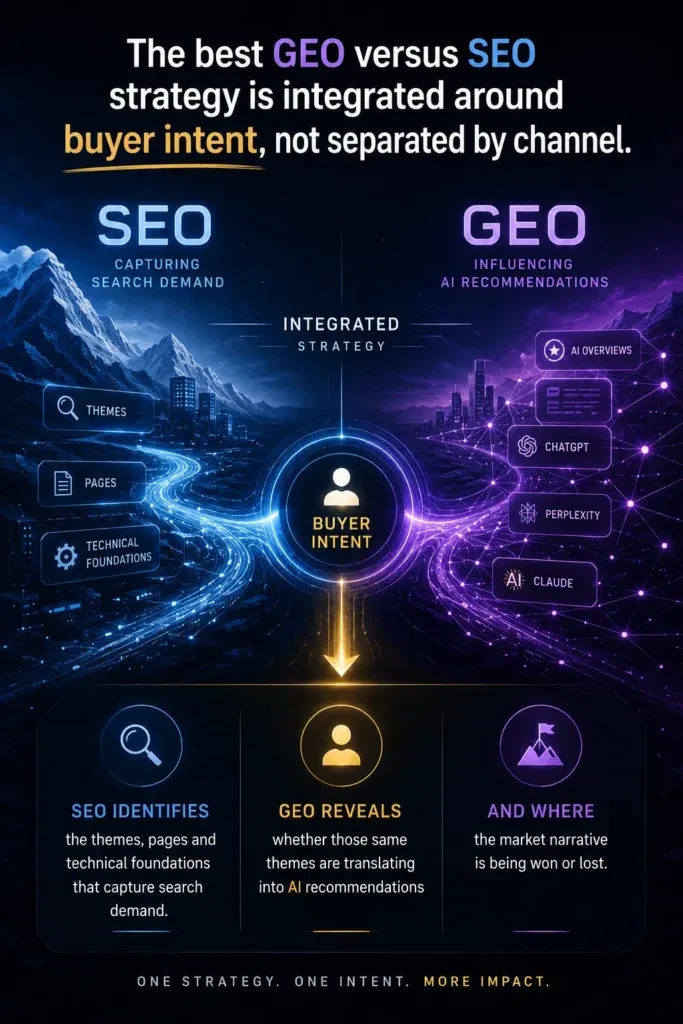
The best GEO versus SEO strategy is integrated around buyer intent, not separated by channel. SEO identifies the themes, pages and technical foundations that capture search demand. GEO reveals whether those same themes are translating into AI recommendations and where the market narrative is being won or lost.
Start by mapping your highest-value topics to both keywords and prompts. A keyword may be “project management software for architects”. The related prompt set should include natural questions: which tools are best for architectural firms, what features matter for project profitability, and which platforms integrate with accounting systems. This gives the team a more realistic view of how prospects research.
Next, connect your content backlog to evidence. Prioritise assets that can close a measured visibility gap: a definitive use-case page, a clear comparison, current customer proof, a technical explainer or a refreshed article with specific answers. Avoid publishing generic thought leadership simply because it feels like content activity. If it will not improve authority, citation potential or conversion, it should not lead the queue.
Finally, establish a regular competitive review. Competitors do not need to beat you everywhere to take pipeline. They only need to appear consistently in the prompts buyers use before they know your brand. When their AI share of voice rises, investigate the source evidence, content format and messages supporting that gain, then respond with a stronger and more useful asset.
The decision is not GEO or SEO
For most businesses, the right investment mix depends on maturity. A company with weak technical SEO and little useful owned content should fix those foundations while building baseline AI visibility tracking. A brand already ranking well but losing inclusion in AI answers should shift more effort towards GEO-led content, entity clarity and third-party credibility. Enterprise teams with established search programmes need both, with shared reporting and a single commercial view of visibility.
What cannot wait is measurement. You cannot optimise a market position you cannot see. Platforms such as aigeo insights make that process operational by tracking mentions, citations, sentiment and competitor visibility across leading generative engines, then translating the data into prioritised optimisation actions.
The search result is no longer the only place a buyer makes a choice. Build the pages that rank, but also build the proof, clarity and authority that make an AI confident enough to name you. The brands that act now will not merely appear in search. They will shape the answer buyers receive.
Related Posts
- How to Increase AI Citations and Win AI Search
Learn how to increase AI citations with content, entity signals and measurement that put your brand in more AI-generated answers…
Read more - How to Measure Brand Visibility in AI Search
Learn how to measure brand visibility across AI search, track share of voice, citations and sentiment, and turn visibility gaps…
Read more - What an AI Search Visibility Tool Should Do
See what an AI search visibility tool should track, why rankings miss the point, and how brands can lift citations,…
Read more