
If your brand is mentioned in ChatGPT, Gemini, Claude or Google AI Overviews, the mention alone is not the win. The real question is brand sentiment in AI answers. Are you being framed as trusted, overpriced, risky, innovative, niche, or simply second best? That framing now influences clicks, shortlist decisions, and purchase intent before a user ever reaches your site.
This is where a lot of teams are still using an old search mindset. They track rank, traffic and maybe branded mentions, then assume visibility equals value. It does not. In AI-generated environments, the answer itself carries interpretation. The model is not just listing brands. It is compressing public signals into a recommendation layer, and that layer can move commercial outcomes fast.
What brand sentiment in AI answers actually means
Brand sentiment in AI answers is the qualitative tone and positioning an AI system assigns to your brand when it includes you in a response. It is not limited to obvious positive or negative wording. In practice, sentiment can be subtle. A model might describe one provider as reliable and another as budget-friendly. Both are technically positive, but they lead buyers in very different directions.
That difference matters because AI answers are increasingly acting as the first filter. Instead of reviewing ten blue links, users ask for the best software for a use case, the safest provider in a category, or the most cost-effective option for a team size. The brands that appear are important. The brands that appear with the strongest commercial framing are the ones that win attention.
For marketers, this means sentiment is not a soft metric. It is a performance signal. If your brand is repeatedly associated with weak support, limited features, premium pricing without justification, or unclear differentiation, that pattern can suppress demand even when your visibility looks healthy on paper.
Why sentiment matters more than mention count
A raw mention count can tell you whether you are present. It cannot tell you whether the answer is helping or hurting you. That distinction is now critical.
Imagine your brand appears in 40 per cent of AI responses across a category. Sounds strong. But if the surrounding language consistently positions competitors as easier to use, better value, or more suitable for enterprise buyers, your share of voice is misleading. You are visible, but not advantaged.
This is why sentiment should be read alongside frequency, citation rate and competitor presence. One brand may be cited less often but framed with stronger authority. Another may dominate mentions while being described as a fallback option. The leaderboard alone will not show the difference.
For agencies and in-house growth teams, this creates a more disciplined way to assess AI performance. The question is no longer, “Are we showing up?” It is, “How are we being introduced to the market when AI is doing the talking?”
What shapes sentiment inside AI-generated answers
AI systems do not invent brand positioning from nowhere. They infer it from the material they can access, absorb and trust. That includes your own content, third-party reviews, publisher coverage, category round-ups, forums, structured product information, comparison pages and repeated language patterns across the web.
If your content is vague, inconsistent or over-written, models have less clear material to work with. If external sources describe you more sharply than you describe yourself, those sources may shape the answer more than your site does. That is one of the biggest shifts in GEO. Your brand narrative is no longer controlled by your homepage copy alone.
Citation patterns matter too. When AI systems can anchor claims to trusted sources, those claims become more durable. A brand that is regularly cited by strong domain sources, clearly categorised, and consistently described in similar terms has an advantage. It gives the model a stable profile to reproduce.
There is also a competitive layer. AI answers are comparative by nature. Even when a user asks about one brand, the model often frames it against alternatives. That means your sentiment is partly influenced by how cleanly your differentiators hold up next to competitor narratives. If their content is more specific and their third-party validation is stronger, they may inherit better positioning even with similar products.
The most common reasons brands lose sentiment
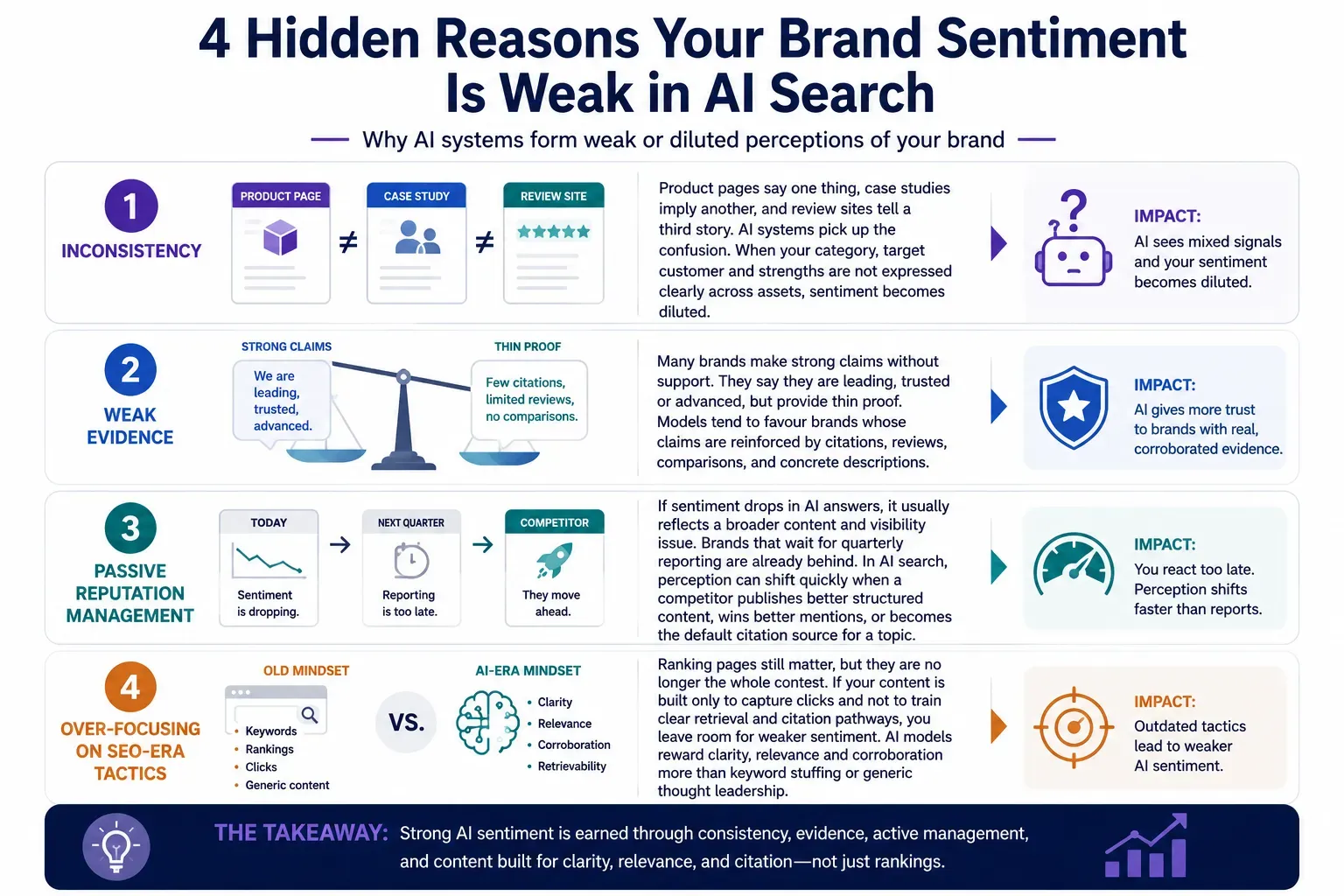
The first problem is inconsistency. Product pages say one thing, case studies imply another, and review sites tell a third story. AI systems pick up the confusion. When your category, target customer and strengths are not expressed clearly across assets, sentiment becomes diluted.
The second is weak evidence. Many brands make strong claims without support. They say they are leading, trusted or advanced, but provide thin proof. Models tend to favour brands whose claims are reinforced by citations, reviews, comparisons, and concrete descriptions.
The third is passive reputation management. If sentiment drops in AI answers, it usually reflects a broader content and visibility issue. Brands that wait for quarterly reporting are already behind. In AI search, perception can shift quickly when a competitor publishes better structured content, wins better mentions, or becomes the default citation source for a topic.
The fourth is over-focusing on SEO-era tactics. Ranking pages still matter, but they are no longer the whole contest. If your content is built only to capture clicks and not to train clear retrieval and citation pathways, you leave room for weaker sentiment. AI models reward clarity, relevance and corroboration more than keyword stuffing or generic thought leadership.
How to measure brand sentiment in AI answers properly
You cannot manage this with screenshots and anecdotal prompts. The useful approach is repeatable tracking across platforms, prompts, competitors and time.
Start by monitoring how your brand is described in commercial and informational queries that actually influence pipeline. Not every prompt matters equally. A category comparison query, a best-for-use-case query, and a trust-oriented query often reveal far more than vanity prompts about your company name.
Then compare sentiment by platform. ChatGPT may frame your brand differently from Perplexity or Google AI Overviews because source handling, retrieval patterns and answer structure vary. If one platform consistently positions you better, that is a clue about which assets are influencing outcomes.
Competitor benchmarking is equally important. Sentiment only becomes commercially useful when you can see who is winning the framing battle. Are rivals being called more scalable, more affordable, or easier to deploy? Are they cited more often when high-intent prompts are asked? This is the layer many teams miss.
Finally, tie sentiment shifts to actions. If an updated comparison page, improved schema, stronger review acquisition or a fresh set of category explainers leads to better AI framing, that is operationally valuable. It tells you what to do more of. Platforms such as aigeo insights are built for this exact shift from passive analytics to a roadmap that shows teams where to act next.
How to improve brand sentiment in AI answers
The fix is rarely one page or one prompt. It is a coordinated content and evidence strategy.
Start with message discipline. Your brand needs a stable set of claims that are clear, commercially relevant and repeated consistently across key assets. If you want to be known for speed of implementation, enterprise control, lower total cost, or support quality, say it plainly and support it everywhere.
Next, strengthen the assets AI systems are most likely to draw from. Category pages, product explainer pages, comparison content, pricing context, customer proof and third-party mentions all shape how models describe you. Generic blog posts will not carry the load on their own.
You also need better corroboration. That can include structured product data, clearer authorship, stronger review signals, more quotable proof points, and external coverage that reflects the market position you want. Sentiment improves when claims are not just published, but backed.
There is a trade-off here. Aggressive positioning can lift visibility, but if it is not supported, it can trigger weaker sentiment or omission. The smarter move is precise differentiation. Give AI systems clean, credible language to use, not inflated copy they have to second-guess.

The teams that will win this next phase
The winners in AI search will not be the brands with the loudest claims. They will be the brands with the clearest market narrative, the strongest evidence, and the fastest optimisation loop.
That is the shift. Search used to reward discoverability first and persuasion second. AI answers collapse those stages together. The recommendation is often delivered before the click. That means sentiment is now part of acquisition, not just reputation.
For brand marketers, SEOs, agencies and growth teams, the implication is straightforward. Track mentions, yes. But do not stop there. Measure how your brand is being framed, where that framing is coming from, and which competitor narratives are outranking yours inside the answer itself.
The battle for visibility is no longer just about being found. It is about being described in a way that makes buyers choose you.
Related Posts
- Can AI Answers Misquote Brands? Yes, They Can
Can AI answers misquote brands? Learn why generative search gets claims wrong, how to spot risk, and what to do…
Read more about Can AI Answers Misquote Brands? Yes, They Can - Answer Engines Are Reshaping Brand Discovery
Answer engines are changing how Australians discover, compare and trust brands. Learn what to measure and how to earn visibility…
Read more about Answer Engines Are Reshaping Brand Discovery - How to Map Brand Entities for AI Search Visibility
Learn how to map brand entities, connect the signals AI uses, find gaps and build a stronger path to citations,…
Read more about How to Map Brand Entities for AI Search Visibility