
When a buyer asks ChatGPT which platform to use, asks Gemini for a shortlist, or scans a Google AI Overview before clicking anything, your brand positioning is being decided in public. Often without your team knowing what was said, which competitor was recommended, or what source informed the response. Brand positioning in generative results is no longer a messaging exercise alone. It is a visibility, evidence and competitive-intelligence problem.
The battle for the answer has begun. Brands that appear frequently, accurately and favourably in AI-generated responses gain a head start before the prospect ever reaches a website. Brands that are absent are not merely losing traffic. They are losing consideration.
Why generative results change positioning
Traditional search positioning was largely expressed through rankings, paid placements, landing pages and the snippets users chose to click. Generative engines compress that journey. They interpret the question, select supporting sources, form an answer and may recommend only a handful of options.
That compression raises the stakes. A buyer may see your company described as affordable, enterprise-ready, specialist or not mentioned at all. Each outcome creates a position in the buyer’s mind. And because AI answers feel synthesised rather than promotional, recommendations can carry disproportionate weight.
This does not mean SEO is obsolete. Strong technical foundations, useful content and recognised authority still matter. But the unit of competition has changed. You are competing to be included in the answer, cited as credible evidence and framed around the attributes that help your business win.
A high organic ranking without an AI mention can leave a visibility gap. Equally, an AI mention that repeatedly associates your brand with a narrow or outdated capability can limit demand. The objective is not vanity exposure. It is accurate, commercially useful representation.
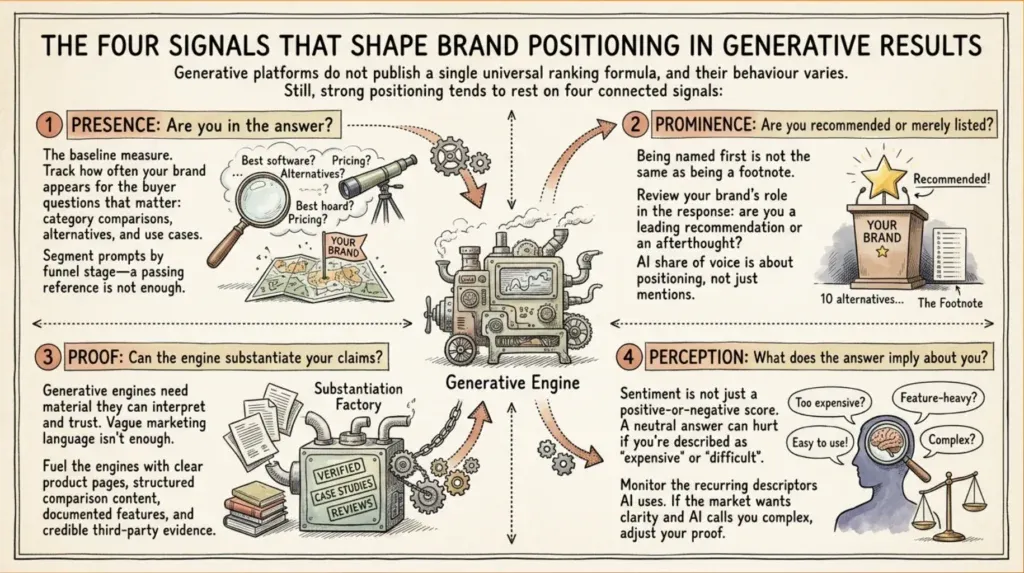
The four signals that shape brand positioning in generative results
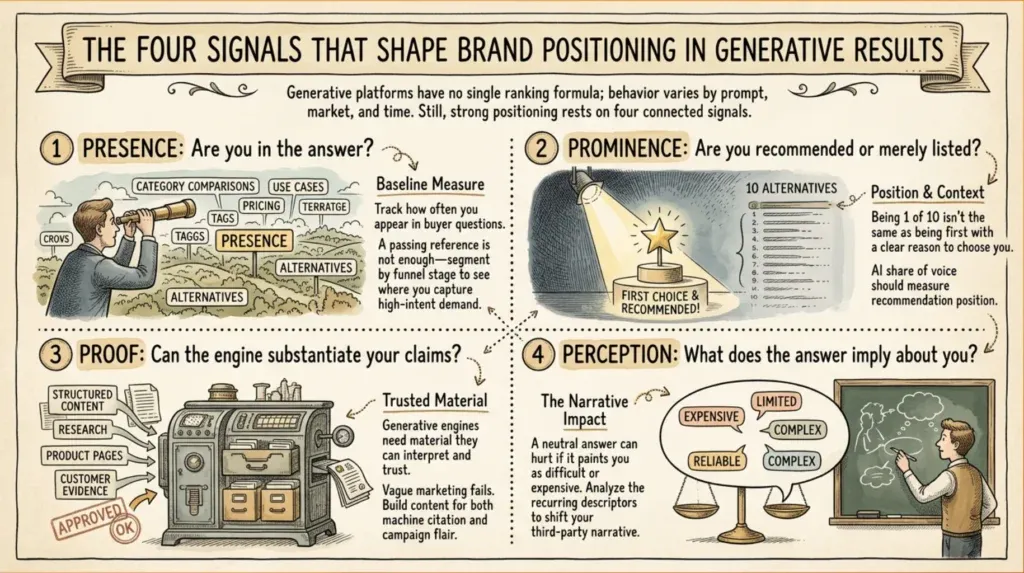
Generative platforms do not publish a single universal ranking formula, and their behaviour varies by prompt, market and time. Still, strong positioning tends to rest on four connected signals: presence, prominence, proof and perception.
Presence: are you in the answer?
Presence is the baseline measure. Track how often your brand appears for the buyer questions that matter: category comparisons, use cases, problem-led queries, alternatives, pricing considerations and implementation concerns.
A broad count is not enough. A mention in response to “best accounting software for Australian tradies” has a different commercial value from a passing reference in a generic definition. Segment prompts by funnel stage and business priority. This reveals where awareness exists and where competitors are capturing high-intent demand.
Prominence: are you recommended or merely listed?
Being mentioned alongside ten alternatives is not the same as being named first with a clear reason to choose you. Review the role your brand plays in the response. Is it a leading recommendation, a viable option, an alternative for a specific need or a footnote?
Prominence is where positioning becomes tangible. If AI routinely recommends a competitor for reliability, speed or value, that competitor is accumulating an advantage even if your own brand receives occasional mentions. AI share of voice should therefore be measured alongside recommendation position and the contexts in which brands appear.
Proof: can the engine substantiate your claims?
Generative engines need material they can interpret and trust. Vague marketing language rarely gives them much to work with. Clear product pages, structured comparison content, documented features, original research, credible third-party coverage and detailed customer evidence are more useful because they make claims easier to verify.
The trade-off is straightforward: content built solely for citation can become dry and interchangeable, while content built purely for campaign flair may lack the detail machines need to represent it correctly. The strongest assets do both. They make a distinct claim, explain it plainly and support it with specific evidence.
For example, “helps teams improve AI visibility” is broad. “Tracks brand mentions, citations, sentiment and AI share of voice across ChatGPT, Claude, Gemini, Perplexity and Google AI Overviews” gives both buyers and generative systems something concrete to understand.
Ready to get started?
A one-line nudge that earns the click below.
Perception: what does the answer imply about you?
Sentiment matters, but it should not be treated as a single positive-to-negative score. A neutral answer can still be damaging if it presents your brand as expensive, limited, difficult to implement or suitable only for smaller teams. Likewise, a positive answer can be commercially weak if it praises an attribute your best customers do not prioritise.
Analyse the descriptors that recur around your company and your competitors. These are the raw materials of market perception. If the market wants control and clarity but AI describes you as feature-heavy, your content, proof points and third-party narrative may need to change.
Build a measurement system before you publish more content
The reflex response to falling AI visibility is to publish at speed. That can waste budget. First establish a benchmark that shows where you stand and what is actually causing the gap.
Start with a representative prompt set. Include the category questions buyers ask, but also the questions they ask before and after choosing a category. Think “how do I solve this problem?”, “which providers suit this business type?”, “what should I compare?” and “what are the risks of switching?” Add location and industry qualifiers where they materially affect the answer.
Then run those prompts consistently across the platforms relevant to your audience. ChatGPT, Claude, Gemini, Perplexity and Google AI Overviews can produce different brand landscapes. A competitor may dominate research-oriented queries in Perplexity while barely appearing in Google. Treating AI search as one channel hides these opportunities.
For each response, measure mention frequency, citation rate, recommendation status, sentiment, AI share of voice and competitor visibility. Capture the sources cited when they are available. The goal is to move from anecdotes such as “we saw a bad answer” to patterns such as “we are absent from 68 per cent of high-intent comparison prompts, while Competitor B is cited through independent review pages and detailed integration documentation”.
This is where a platform such as aigeo insights earns its place. The value is not another dashboard. It is turning platform-level visibility data into a prioritised roadmap: which page to improve, which comparison to create, which proof point to clarify and which external sources may be shaping the answer.
Turn visibility gaps into a positioning plan
Once the data is clear, do not try to fix everything at once. Prioritise the gaps with the strongest combination of commercial intent, competitive weakness and realistic ability to improve.
If your brand is missing from buyer shortlists, build assets that answer the shortlist question directly. If you are present but described inaccurately, update core pages with sharper definitions, current capabilities and evidence that resolves the misunderstanding. If competitors own a feature narrative you can credibly challenge, publish a focused comparison supported by facts, not chest-thumping.
The work usually spans four areas:
- Core entity clarity: Make it unambiguous what you do, who you serve, where you operate and how your offer differs.
- Evidence-rich content: Create useful product, use-case, comparison and implementation content with claims that can be substantiated.
- Source distribution: Earn credible mentions beyond your own site through relevant publications, partners, customers and industry resources.
- Ongoing monitoring: Track changes in AI responses, competitor movement and citation patterns so the roadmap stays current.
Do not assume every visibility deficit needs a new article. Sometimes the highest-impact action is refreshing a stale product page, adding a missing pricing explanation, correcting inconsistent descriptions across the web or strengthening a weak customer proof point. Generative results reflect the information environment around your brand, not just your content calendar.
Avoid the positioning traps that cost visibility
First, avoid measuring only branded prompts. If someone already asks an AI engine about your company, you have won a meaningful share of awareness. The larger opportunity lies in unbranded category and problem prompts, where new buyers decide which names belong in the conversation.
Second, avoid chasing mentions without checking quality. More mentions are not automatically better if they occur in low-value contexts or reinforce the wrong message. Track whether AI answers connect your business to the attributes that drive qualified demand.
Third, avoid treating results as fixed. Generative answers can change quickly as models, retrieval systems, source material and competitors evolve. Monthly monitoring may suit stable categories, while fast-moving markets and active campaigns may require weekly checks. The right cadence depends on how quickly your category changes and how much revenue is attached to being recommended.
Positioning is now an operating discipline
The brands winning AI search will not be the ones with the loudest claims. They will be the ones that can see how AI systems describe them, identify where competitors are gaining ground and act on evidence before a narrative hardens.
Your next move is practical: choose the questions that create revenue, inspect the answers buyers receive, and decide what your brand must be known for when the engine responds. The answer economy rewards clarity, proof and speed. Make sure the answer includes you for the right reasons.
Related Posts
- What Affects AI Brand Mentions in AI Search?
Learn what affects AI brand mentions across ChatGPT, Gemini and Google AI Overviews, then turn visibility data into a sharper…
Read more about What Affects AI Brand Mentions in AI Search? - Generative Search Strategy for Marketers
Build a generative search strategy for marketers that measures AI visibility, earns citations and turns competitive insights into practical, fast…
Read more about Generative Search Strategy for Marketers - Generative Search Content Optimisation Guide
This generative search content optimisation guide shows Australian marketing teams how to earn AI citations, lift share of voice and…
Read more about Generative Search Content Optimisation Guide