
A prospect asks ChatGPT which provider to shortlist. Your company has the right product, credible customers and years of search authority – yet it is missing from the answer, described inaccurately, or placed behind a competitor. That is the commercial cost of chatbot brand errors. In the answer economy, a wrong or absent brand mention is not a cosmetic issue. It can remove you from consideration before a buyer reaches your website.
Generative platforms do not read your brand as a human does. They assemble answers from patterns across websites, first-party content, reviews, publications, directories and other sources. If those signals are inconsistent, stale or thin, AI systems have less confidence in who you are, what you do and when to recommend you.
Why chatbot brand errors now affect pipeline
Traditional rankings still matter, but they no longer tell the full visibility story. A buyer may ask Claude for a comparison, Gemini for a local recommendation, Perplexity for sources, or Google AI Overviews for a quick answer. In each case, the platform can shape the shortlist without sending a click to every brand it mentions.
That changes the job for marketing, SEO and growth teams. You need to know whether your brand is mentioned, cited, framed positively and positioned against competitors across the prompts that matter commercially. You also need to separate a one-off strange response from a persistent visibility problem.
Not every incorrect answer is proof that your brand has failed. Models vary by platform, prompt wording, location, conversation context and product updates. But repeated gaps across high-intent queries are a signal: your brand evidence is not strong, clear or widely distributed enough to be selected consistently.
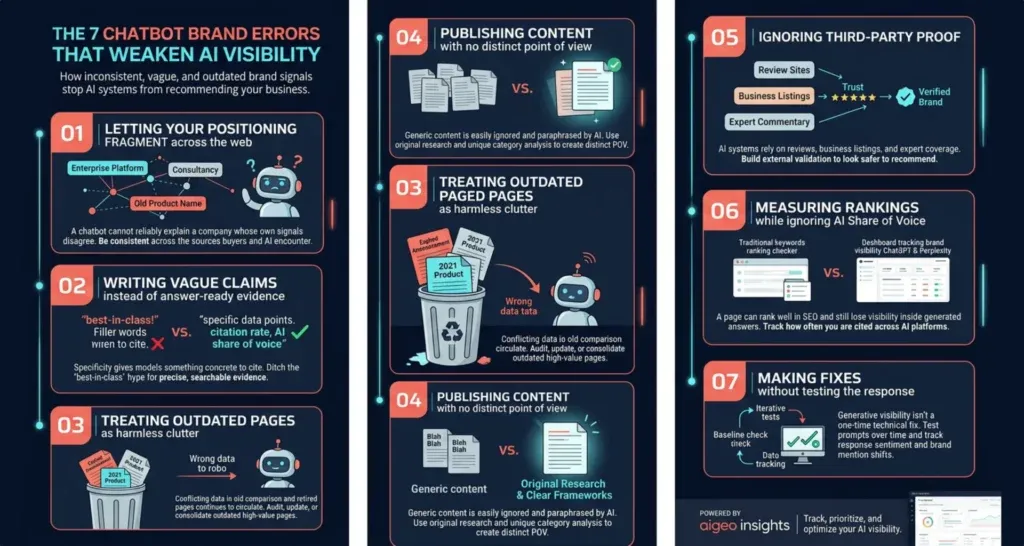
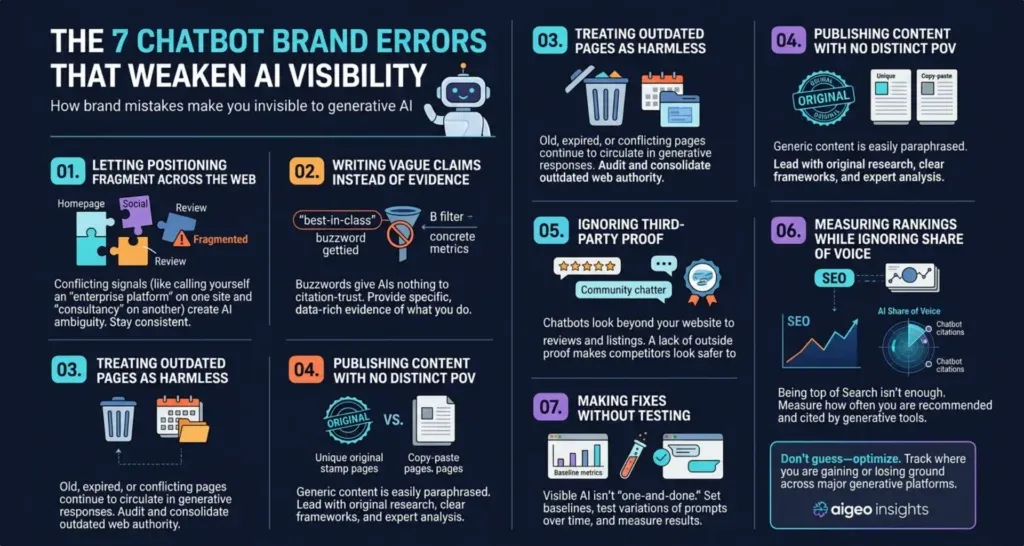
The 7 chatbot brand errors that weaken AI visibility
1. Letting your positioning fragment across the web
A chatbot cannot reliably explain a company whose own signals disagree. Your homepage calls you an enterprise platform, a directory lists you as a consultancy, a social profile uses an old product name, and a review site describes features you retired two years ago. The result is ambiguity.
Start with the fundamentals: your company name, category, audience, core use cases, product terminology, leadership details and service areas. These details should be consistent across the sources buyers and AI systems are likely to encounter. Consistency does not mean repeating the same copy everywhere. It means every description tells the same underlying story.
2. Writing vague claims instead of answer-ready evidence
Phrases such as “leading solution” and “best-in-class platform” may sound confident, but they give an AI little useful material to retrieve or cite. Systems respond better to verifiable detail: what the product does, who it is for, how it works, what it integrates with, what it costs where appropriate, and what measurable outcome it supports.
Turn marketing language into clear evidence. A page explaining that a platform tracks brand mention frequency, citation rate, AI share of voice and sentiment across named generative engines is more useful than a page that simply promises better AI visibility. Specificity gives models something concrete to associate with your brand.
3. Treating outdated pages as harmless clutter
Old comparison pages, retired product pages and expired announcements do more than create a messy website. They preserve conflicting claims that can continue circulating in generative responses. A chatbot may cite an old price, recommend a discontinued feature, or describe your company through a category you left behind.
Audit the pages that rank, earn links or appear in branded searches first. Update high-value material where the current page still has authority. Consolidate duplicate content where necessary. Remove or redirect pages that no longer represent the business. The trade-off is real: deleting a page can discard useful historical equity, so assess its traffic, citations and backlinks before acting.
4. Publishing content with no distinct point of view
Generic content is easy for AI systems to paraphrase and easy for competitors to match. If your guides say what every other brand says, there is little reason for a model to mention you by name. Original research, clear frameworks, practical implementation detail and honest category analysis create stronger association.
This does not require publishing thought leadership for its own sake. Create material that resolves the questions your prospects actually ask before buying: how to assess a platform, what metrics matter, where implementation fails, and which trade-offs apply at different company sizes. Give the answer a perspective that is recognisably yours.
Ready to get started?
A one-line nudge that earns the click below.
5. Ignoring third-party proof
Your website is essential, but self-published claims are only one part of the evidence environment. AI platforms may draw on reviews, reputable coverage, expert commentary, community discussions, partner pages and structured business listings. When these sources are sparse or inaccurate, competitors with broader proof can look safer to recommend.
The goal is not to manufacture mentions or chase every directory. Focus on credible places where customers research your category. Encourage genuine reviews, correct inaccurate business profiles and equip partners with current company descriptions. Third-party validation is especially valuable for claims around reliability, customer experience and market credibility.
6. Measuring rankings while ignoring AI share of voice
A page can rank well and still lose visibility inside generated answers. Conversely, a lesser-known page may become a useful citation because it answers a narrow question clearly. Teams that only track keyword positions are watching one part of the battlefield.
Measure the prompts that map to discovery, evaluation and purchase intent. Track how often your brand appears, whether it is cited, the sentiment attached to it, which competitors appear beside it and which platform produces the gap. This turns a vague concern – “we are not showing up in AI” – into an operational priority.
For example, a brand might be mentioned regularly in ChatGPT but absent from Perplexity answers that cite industry research. That points to a different action than a Google AI Overview problem. One may require stronger source-worthy content; another may expose weak category pages or poor entity clarity.
7. Making fixes without testing the response
The final chatbot brand error is assuming that publishing a page solves the problem. Generative visibility is not a one-time technical fix. Models update at different speeds, source selection changes, and competitors continue publishing.
Set a baseline before you change anything. Then test a controlled set of commercially important prompts over time, using consistent wording as well as realistic variations. Record the response, brand mention, citations, competitor set and sentiment. When visibility changes, connect it to the pages, source corrections or content assets you updated.
This is where an AI visibility tracker earns its place. aigeo insights can show where a brand is gaining or losing ground across major generative platforms, then translate those findings into prioritised content and optimisation actions. The aim is not to chase a single flattering answer. It is to build repeatable evidence that improves your chance of being selected across relevant buyer questions.
How to prioritise chatbot brand errors
Do not begin with the most embarrassing response. Begin with the error that intersects with revenue. A wrong office address may matter greatly for a local business, while a SaaS company may need to fix category confusion or missing competitor-comparison visibility first.
Prioritise issues using three questions. Is the prompt high intent? Is the error repeated across platforms or tests? Can you influence the underlying source with a realistic change? A repeated absence on “best software for [use case]” deserves more attention than an odd answer to a broad, low-value question.
Then match the remedy to the cause. Entity confusion calls for consistent first-party and profile information. Missing citations call for detailed, sourceable resources. Negative framing may require better customer proof or a product narrative that addresses a known objection. No single GEO tactic fixes every visibility gap.
Build a brand that AI can represent accurately
The battle for the answer is not won by stuffing pages with AI keywords or trying to force models to repeat a slogan. It is won by making your brand easy to understand, easy to verify and difficult to overlook.
Treat every high-intent AI response as a new point of competition. Monitor what is being said, repair the evidence behind the errors, and keep testing where buyers are asking. The brands that act while generative search habits are still forming will not merely appear in more answers – they will shape the shortlist buyers trust.
Related Posts
- LLM Monitoring Software for AI Brand Visibility
LLM monitoring software reveals where AI mentions, cites and recommends your brand, so teams can protect share of voice before…
Read more about LLM Monitoring Software for AI Brand Visibility - How to Map Brand Entities for AI Search Visibility
Learn how to map brand entities, connect the signals AI uses, find gaps and build a stronger path to citations,…
Read more about How to Map Brand Entities for AI Search Visibility - LLM Analytics Review for Brands That Want Visibility
An LLM analytics review for marketers: assess AI visibility, citations, sentiment and competitors, then turn data into actions that grow…
Read more about LLM Analytics Review for Brands That Want Visibility